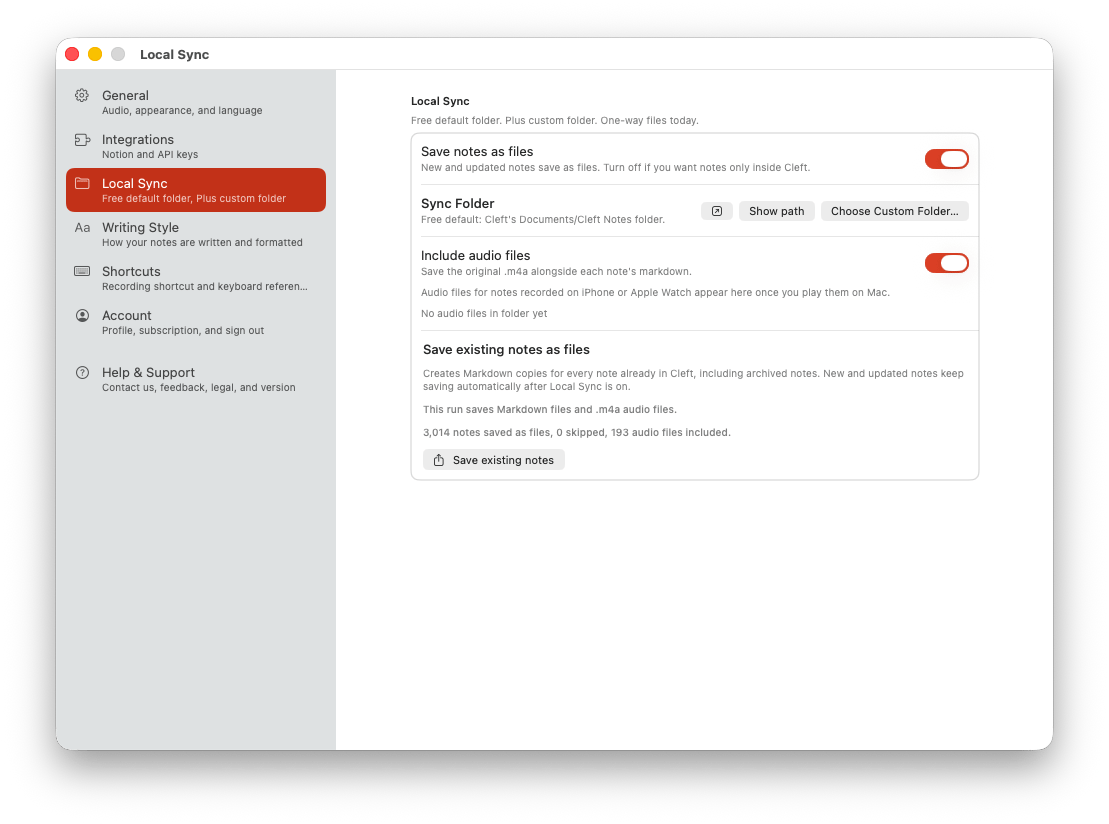
Save every Cleft note as a Markdown file on Mac, iPhone, or iPad. Works with Obsidian, NotePlan, Logseq, Drafts, or any folder
Local Export is free for every Mac, iPhone, and iPad user as of v1.14.0. Cleft Plus lets you point exports at a custom folder: your Obsidian vault, a NotePlan project, a Logseq graph, or anywhere on disk. Free users get Cleft’s own Cleft Notes folder.
Local Export writes every Cleft note to your device as a .md file. The note’s attachments go in a folder next to it, and with Save audio files on, the original recording sits beside it as an .m4a. Each file carries the whole note: its title, tags, dates, summary, and full transcript. When you record a new note, edit a title, change a tag, or a note arrives via cross-device sync, the file on disk updates to match. Works on Mac, iPhone, and iPad.Local Export is an export. It adds copies to your folder without changing how Cleft otherwise stores, syncs, or processes your notes and recordings.Export is one-way: Cleft is the source of truth. Edits you make to the .md files in your vault are silently overwritten the next time Cleft syncs that note. Same contract as Notion auto-send.
In Cleft v1.15.0 or later, Settings → Local Export → Export mode offers two choices:
Automatic export. Recommended, and what Local Export has always done. New and updated notes are exported to your folder automatically.
Manual export. Nothing is saved until you ask. Open a note and choose Send → Send to Folder to export that one.
Existing setups stay on Automatic export, and your choice follows you across devices.
On Manual export, turn on Archive after send to move a note out of your active library once the complete export succeeds. It is a tidy “I’m done with this one” gesture, and the note is always recoverable from the Archived filter.
When Archive after send archives a note, Cleft updates the exported file’s archived: line to match, so the file does not sit there calling the note active moments after you archived it.If you pick Send to Folder before choosing a folder, Cleft tells you to set one up in Settings first. A successful send confirms with “Sent to your folder”, and if the archive step fails afterwards, Cleft says so rather than reporting the whole send as failed.Send to Folder also works on Automatic export. It exports that one note right away.
Any folder you pick (Obsidian vault, NotePlan project, Logseq graph, etc.)
Audio companion (.m4a)
Free toggle
Free toggle
Turn it off
Free toggle
Free toggle
Plus differentiates on destination choice, not feature existence. Free users who want exports inside an Obsidian vault, NotePlan folder, or anywhere other than Cleft’s own Cleft Notes folder upgrade to Plus to unlock the picker.
A one-time sheet introduces Local Export on Mac, iPhone, and iPad. From v1.15.0, a new account sees it after the welcome for your first note closes, so you decide about files once there is a note to save. The sheet first shows the two export modes, with Automatic export marked as recommended, then offers:
Use default folder. Accepts Cleft’s own Cleft Notes folder. Nothing else to configure.
Choose folder. Pick your own folder (Plus). Routes to the picker if you’re already on Plus, or to the upgrade screen if you’re not.
Don’t save files. Turns Local Export off entirely. You can change your mind any time in Settings → Local Export.
On Automatic export, choosing either folder option leads Cleft to ask whether to Save existing notes as files or leave that for later. New and edited notes keep saving automatically either way. On Manual export, Cleft skips that offer, because nothing is saved until you send it.You’ll only see the first-launch sheet once. After that, the master “Save notes as files” toggle in Settings is the off-switch.
First-run Local Export prompt on Mac
Already had Local Export set up before v1.14.0? You’ll see a different sheet (a one-time migration heads-up) that explains what’s about to change on disk and lets you reveal your folder for a backup first. See Migrating from earlier versions below.
The date and time come from when the note was created in UTC.
The slug is a kebab-case ASCII-folded rendering of your title, capped at 60 characters.
The note reference (ID) stays in the file’s cleft_ref: or cleft_id: field. Cleft adds it to the filename only when two files would otherwise have the same name.
Smart title renames. When your title changes (and the slug regenerates), Cleft renames the existing file before overwriting content. On recent Obsidian (1.4 and later) this usually lets Obsidian recognise the rename and keep your wikilinks pointing at the note. It stays best-effort, though: on a slow disk, a busy system, or an iOS-only Obsidian setup, the rename can register as a delete-and-create and break links. If that happens, recover the note by its reference in the frontmatter (see Troubleshooting).
Every file carries the whole note, whichever tab you had open in Cleft. By default, Cleft writes this shape:
---cleft_ref: "7GmQ2xB4TzS1pKdL9nRvAw"cleft_account_ref: "8kP3vWxJ4mN7tYqL2sRzFh"title: "My note title"tags: ["work", "ideas"]created: 2026-05-06T10:30:00Zupdated: 2026-05-06T11:15:00Zarchived: falsesource: clefttranscript: "full transcript on one line"language: "en"style: "formatted"---AI-generated summary goes here.## Audio[2026-05-06-10-30-my-note-title.m4a](2026-05-06-10-30-my-note-title.m4a)## Attachments#work #ideas
The body starts with the summary. The transcript sits in the frontmatter by default. With the Obsidian, NotePlan, Logseq, or Drafts starting point in Customize the frontmatter, it moves into the body under its own ## Transcript heading, after the summary, where it keeps its line breaks.The ## Audio and ## Attachments sections appear only once those files are actually in your folder, so a file never links to something that is not there. The Obsidian, NotePlan, and Logseq starting points write the links as ![[…]] embeds; every other shape uses standard Markdown links, which any Markdown reader can open.All default keys are lowercase English (never localised), so Obsidian Properties, NotePlan, and Dataview queries work the same regardless of your device language.From v1.15.0 onward, newly exported files use cleft_ref and cleft_account_ref instead of the older numeric cleft_id and cleft_account_id. Existing files keep their original names. See Migrating from earlier versions for details.
Field
What it is
cleft_ref or cleft_id
Stable Cleft note reference. cleft_ref is a 22-character opaque string that does not disclose how many notes exist. Older files use cleft_id with a numeric value. Both name the same note; Cleft does not rewrite existing files. Namespaced under cleft_ so it can’t collide with id: fields written by other tools (Readwise, Notion exports, Templater) sharing your vault. Grep ^cleft_ref: "7GmQ2xB4TzS1pKdL9nRvAw" or ^cleft_id: 12431 to find a note by ID even after manual filename changes.
cleft_account_ref or cleft_account_id
Reference to the Cleft account that owns the exported note. cleft_account_ref is a 22-character opaque string (v1.15.0 onward), older exports use cleft_account_id as a number. Both forms keep notes from different accounts separate when they share one folder.
title
Your note’s title (YAML-quoted, so titles with : or " round-trip safely)
tags
Array of tags as a YAML flow-sequence, clickable in Obsidian’s Properties panel
created
When the note was created (UTC, ISO 8601). For Dataview sorting, NotePlan calendar grouping, Drafts smart folders
updated
When the note was last changed (UTC, ISO 8601)
archived
Whether the note is archived in Cleft. Written for every note, so your folder mirrors your library instead of restoring everything as active. A file without the line was exported before v1.15.0 and is read as not archived
source
Always cleft. Filter for Cleft-originated notes via Dataview
transcript
Full transcript on one line (newlines collapsed to spaces), unless your frontmatter moves it into the body
language
The language the recording was transcribed in, such as "en". Left out when Cleft does not know it
style
The writing style the recording was made with. Only the device that recorded the note knows it, so a note that arrived from another device has no style line
Inline #hashtags after the body light up tag clickability in Obsidian preview, NotePlan search, and Drafts’ tag panel. None of those see the YAML tags: field as clickable.
Version-controlling your vault? Re-exporting an unchanged note produces a byte-identical file, so a git diff only flips lines for real changes. One caveat: when a note’s title changes, Cleft renames the file, which git records as a delete plus an add, so per-file history doesn’t carry across the rename. The note is still recoverable by its reference in the frontmatter.
Every exported file carries note and account references in its frontmatter. In Cleft v1.15.0 or later you can read the exact file a note will contribute to your folder before an export writes it.
Open the note.
Choose Note Details from the More menu.
Open File metadata.
Choose What the export will write.
The panel names the folder the file would go to, or tells you Local Export is off, and then lists every frontmatter field with what it is for. The reveal below shows the finished Markdown. Select it, or use Copy this file.Cleft renders the preview with the same exporter that writes your real files, so the preview and the file cannot drift apart. The preview shows the file as first written: the ## Audio and ## Attachments sections join the real file once those files land in your folder. Opening the preview writes nothing to your folder and changes nothing about your note. Cleft remembers which reveals you left open and restores them next time on that device. Frontmatter stays derived from the note: you change it in Cleft or in Settings → Local Export → Frontmatter, never by editing the preview.
Checking a vault into git, or pointing an AI tool at your folder? Read one note’s preview first. It is the fastest way to see which identifiers leave your device before hundreds of files carry them.
Put Note Details on the toolbar (Mac and iPad). Cleft keeps Note Details in the More menu by default. On a Mac, right-click the note toolbar and choose Customize Toolbar, then drag Note Details in. On an iPad, use the toolbar’s customization control. On iPhone it stays in the More menu, which sits in the bar under your thumb.
In Cleft v1.15.0 or later, open Settings → Local Export → Frontmatter to choose which details Cleft writes at the top of each Markdown file and what those fields are called.Start with the tool that reads your folder:
Starting point
What it changes
Everything
Keeps Cleft’s complete default frontmatter
Obsidian
Moves the transcript into the note body so it does not bury the other Properties
NotePlan
Moves the transcript into the body and leaves out the archive flag
Logseq
Moves the transcript into the body and leaves out the title field, because Logseq uses the filename as the page name
Drafts
Moves the transcript into the body and keeps only the three fields Cleft needs to recognize and update its files, so a draft opens on its content
These are starting points, not separate export modes. After choosing one, you can:
Leave optional fields out or rename them to match your own queries and templates.
Put the transcript in frontmatter as one line or in the note body under a Transcript heading, where its line breaks remain intact.
Add up to eight fields of your own with fixed text values.
Check a live preview produced by the same exporter that writes your real files.
The note and account references, and the Cleft marker, are required. Cleft uses them to recognize its own files, keep accounts separate, and update a note after you rename its file, so they cannot be renamed or removed. Neither reference format can be selected or disabled: Cleft always writes the format that account has, whether cleft_ref/cleft_account_ref or cleft_id/cleft_account_id. Tags continue to appear as inline hashtags even if you leave the tags field out.Cleft stops you from saving duplicate, reserved, or malformed field names and explains choices that may affect another tool. For example, omitting archived makes folder readers treat archived notes as active.Your saved frontmatter follows you to your other devices through iCloud, so a Mac and an iPhone writing to the same folder use the same shape. New and updated notes use it the moment you save.
Saving frontmatter changes affects new and updated notes from that point onward. It does not silently rewrite the folder you already have.To update existing exports, choose Rewrite existing files. Cleft rewrites only Markdown files it owns and leaves every other file alone. You can stop part way; files already updated keep the new shape and the rest keep their previous shape until another run.Reset to Cleft’s default restores the standard shape for future exports. Existing files remain untouched until you choose to rewrite them.
Starting in v1.15.0, newly exported files use cleft_ref and cleft_account_ref instead of numeric cleft_id and cleft_account_id. The new identifiers are 22-character opaque strings that do not disclose your account age or note count.Files Cleft wrote before this change keep their original identifier names and numbers. Cleft does not rewrite files already in your folder on its own. Your folder will hold both kinds, and that is expected rather than a fault.A note gets new identifiers the next time that note changes and is exported. So if you edit a note, change its tags, or it arrives via cross-device sync, the next export writes it with cleft_ref and cleft_account_ref. Notes you do not touch keep their old identifiers indefinitely.To move older files to the new references in one pass, use Rewrite exported files below. It changes only the two identifier lines and leaves the rest of each file as it is.Save existing notes in Settings → Local Export, and Rewrite existing files in the Frontmatter panel, also write every file in your account’s current format, but they do it by exporting your whole library again. They overwrite the Cleft-written files in your folder, so any hand edits you made inside those files are lost, and on a folder under version control you get one commit touching every note.
Settings → Local Export → Rewrite exported files moves files from earlier versions to the new note reference without exporting your library again.
Open Rewrite exported files and choose Show what would change.
Cleft reads your folder and shows two lists before it writes anything: Files this would rewrite, and Files this would leave alone, each with the reason beside it.
Read the lists, then choose Rewrite these files. Nothing runs until you confirm.
What the rewrite does and does not do:
It never touches a file Cleft did not write. Your own notes and templates in the same folder stay exactly as they are, even if they carry a cleft_id line.
In each file it rewrites, it changes at most the two identifier lines and copies everything else through unchanged, including your own frontmatter fields and any edits you made to the body.
A note this device holds no reference for keeps the number it already has, and the list says so.
A file you edit, move, or delete after the preview is skipped. Preview again to include it.
You can stop part way. Files already rewritten are listed, and the rest keep their old identifiers.
If some files could not be rewritten, Cleft reports which ones rather than calling the whole run a failure.
There is no undo inside Cleft, which is why the lists come first. Back up the folder before you confirm if you want a way back.
To read both kinds when you search or query your folder, grep for whichever line appears in each file. For example, grep "^cleft_ref:" *.md finds notes with the new format, and grep "^cleft_id:" *.md finds those with the old format.If an account has not yet been assigned new references, its exports do not change at all. Do not expect every account to see the new identifiers immediately.
The Save audio files toggle in Settings → Local Export controls whether Cleft writes the original audio recording next to each markdown file. Default is on for new installs, off for existing Local Export users (so a vault inside iCloud Drive, Dropbox, or Obsidian Sync doesn’t suddenly start syncing hundreds of MB of audio).
The exported .m4a is the recording as it was made. No perceptual filters touch the file, and only AAC codec artefacts apply. Cleft does not re-encode to MP3, WAV, or FLAC.
Filename mirrors the markdown’s basename: 2026-05-06-15-33-meeting.m4a next to 2026-05-06-15-33-meeting.md. Once the audio is in the folder, Cleft adds an ## Audio section to the note that links to it, so there is nothing to wire up by hand.
On-disk footprint is shown in Settings (file count and total size) so the cost is visible at a glance.
A note recorded on another device (your iPhone, Apple Watch, or another Mac) syncs its text, tags, and summary straight away. If the recording is not on the device doing the export, Local Export downloads it from your Cleft account, when a copy is stored there, and saves it beside the note. New recordings stay on the device that made them unless Upload audio is on (a Cleft Plus setting in Settings → Recording → Audio Storage), so audio Cleft never uploaded only reaches the folder on the device that recorded it.Downloads respect your data plan:
Cleft waits for Wi-Fi before downloading a recording. To allow cellular, a personal hotspot, or Low Data Mode as well, turn on Download audio on cellular, which sits under Save audio files. This choice stays on the device where you set it.
Cleft never downloads a recording over 100 MB, on any connection.
A recording already on this device is always copied, whatever these rules say.
When a rule holds a recording back, the note is still saved, just without its ## Audio section. An .m4a an earlier export already left in the folder stays, and stays linked. Save existing notes tells you how many recordings each rule held back.
Images and files you add to a note are exported into a visible folder beside it, named after the note: 2026-05-06-15-33-meeting-attachments/ next to 2026-05-06-15-33-meeting.md. Once the files have landed, the note gains an ## Attachments section that links to each one. Images show inline and documents are clickable links. When a note’s title changes, its attachments folder is renamed with it.Each note gets its own folder, so two notes with an image called photo.jpg cannot overwrite each other. Cleft keeps a record of the files it put in that folder and only ever removes those. A file you add to the folder yourself stays, and Cleft never takes over a folder it did not create. Obsidian’s own attachment folder, your NotePlan project files, and anything else already in your folder are left alone.If you exported attachments with an earlier version, they sat in a hidden .cleft/attachments/ folder. The next time that note exports, Cleft writes its attachments to the visible folder and then removes the hidden copy it wrote for that note.Files Cleft cannot export, such as an unsupported type or one that is not available on this device yet, are counted and reported rather than stopping the rest of the run. If a later refresh cannot fetch the files again, the links to files already in the folder stay.
If you’re on Plus and want exports to land in your Obsidian vault, NotePlan project, Logseq graph, or anywhere other than the default folder:
1
Open Cleft Settings
Open Cleft Settings (press ⌘ + , or click the gear icon)
Go to Local Export
Find Local Export and click Choose Custom Folder…
2
Select a folder
Pick your Obsidian vault root, NotePlan folder, Logseq graph root, or any folder you want Cleft to write into. In Cleft 1.15.0 or later, Mac writes directly to the folder you choose instead of adding a cleft-inbox subfolder.
Local Export settings on Mac
3
Use the folder
Click Use Folder on the alert. Cleft now has permission to write to the folder, and your notes start exporting instantly.
Use Show in Finder on the Export Folder row to open your active export folder, or Show path to check the exact location. To change folder later, click Choose Custom Folder… again. The old folder stays untouched on disk.
Setup is the same on iPhone and iPad. Open Settings, go to Local Export, and pick a folder:
Free users get Cleft’s own Cleft Notes folder (out of the box, no configuration needed). On iPhone and iPad you’ll find it in the Files app under On My iPhone → Cleft (or On My iPad → Cleft).
Plus users tap Choose Custom Folder… to pick any folder on the device: an Obsidian vault “Store on this iPhone,” a Bear local notebook, or your own custom folder via Files app. On iPhone and iPad, Cleft writes to the exact folder you select.
iCloud Drive folders work but are best-effort; Files-app local folders are the recommended path. Once you’ve picked a folder, your notes start exporting immediately. Use Show path in Settings to check the active location.
On Automatic export, Local Export saves new and updated notes once it is on. If you want Markdown files for notes that were already in Cleft, use Save existing notes as files in Settings → Local Export. The run covers your whole library, archived notes included, and each archived note’s file says archived: true, so your folder mirrors your library instead of bringing everything back as active.A run saves Markdown files, your supported attachments, and (unless you have turned Save audio files off) the .m4a audio for each note. Cleft keeps the attachments it fetches apart from any attachments folder you already use. Anything Cleft cannot fetch is counted and reported at the end instead of stopping the run. Recordings follow the download rules above, and the summary says how many were left out because downloads on cellular are off and how many because they are over 100 MB.While the backfill runs, Cleft shows progress and keeps the regular Local Export controls available. You can cancel the backfill without turning off automatic saving for new or updated notes.
Backfill existing notes from Local Export settings
The setup is the same for every app. Point Local Export at the right folder. Each app page covers how the synced files render and any app-specific tips:
Obsidian. Frontmatter renders as Properties; wikilinks preserved on title renames; Dataview-friendly.
NotePlan. Inline tags clickable; project-folder workflow; calendar views are filename-driven.
Logseq. Point the picker at <your-graph>/pages/. Cleft notes appear as Logseq pages alongside the rest of the graph; inline #tags work natively.
Drafts. Drafts is database-backed, not folder-watched. Use Send → Send to Drafts for a single note. Local Export works as a file-based archive you can drag-drop or import, and the Drafts starting point in Customize the frontmatter keeps the top of each file short.
Bear. Like Drafts, Bear stores notes in its own database, so it isn’t folder-watched. Use Send → Send to Bear for a single note, or Local Export plus manual import for a file archive.
Starting in v1.15.0, Cleft uses opaque 22-character references instead of numbers for note and account identification. You will not see a one-time migration sheet for this change: it happens silently in the background.Old files keep their numeric cleft_id and cleft_account_id fields. New exports write cleft_ref and cleft_account_ref instead. Your folder will hold both kinds, and both work equally well. Cleft recognizes both formats and uses whichever one each file carries.The change is per-account and happens gradually. If your account has not yet been assigned new references, your exports will keep using the old numeric format. Do not expect every account to receive new identifiers immediately.To move older files to the new references in one pass, use Rewrite exported files. See File identifiers: old and new above for more detail.
If you had Local Export set up before v1.14.0, you saw a one-time sheet on Mac, iPhone, or iPad launch explaining what was about to change on disk:
Filenames migrated from cleft_12431.md to a readable name such as 2026-05-06-15-33-meeting-with-jonny.md. Cleft adds the note ID only if that name would collide. Migration is lazy and per-note. Each file gets renamed the next time that note is edited or re-exported. Notes you never touch again keep the old name indefinitely.
Frontmatter gained cleft_id: as the first field and switched to lowercase English keys (title: not Title:). Any Dataview or Templater queries on the old Title key needed updating.
Audio companion export was available but stayed off for existing vaults. Turn it on from Settings if you want it. Defaulting it on for an existing vault inside iCloud Drive or Dropbox would create a sudden bandwidth spike on the next recording.
On Mac, the sheet had a button that opened your folder in Finder, so you could take a backup before the migration began. On iPhone and iPad, navigating to your folder via Files had the same effect. The “Got it” button dismissed the sheet permanently.
Check Settings → Local Export. Is the master “Save notes as files” toggle on? It wins over every other setting.
Look for the folder. Free users land in Cleft’s own Cleft Notes folder, which is in the Files app under On My iPhone (or iPad) → Cleft. On Mac, v1.15.0 moves that folder once, with everything in it, to a new location, so use Show in Finder rather than a location you saved before. With Plus, Cleft writes directly to the custom folder you picked on Mac, iPhone, or iPad.
On Mac, use Show in Finder on the Export Folder row to open the active folder, or Show path to check the exact location. On iPhone and iPad, use Show path, then open that location in Files.
Did the note actually save in Cleft? If it’s not in Cleft’s own list, this is a recording issue, not a sync issue.
On iPhone or iPad, is your folder inside iCloud Drive? iCloud Drive support is best-effort in this release. Try a local Files-app folder (Obsidian “Store on this iPhone”, Bear local notebook, or any local folder) for the most reliable path.
On Mac, folder on a network drive (SMB, Dropbox)? Those can be flaky with security-scoped bookmarks. Try a local folder first.
Cleft won’t accept the folder I pickedCleft names the reason rather than failing silently, and your existing folder and setup stay as they were until a new choice works:
“That folder is read-only.” Pick a folder Cleft can write to.
“That folder isn’t available right now.” Usually an external drive or a cloud folder that is offline. Reconnect it, or choose another folder.
“That cloud folder isn’t available right now.” Open it once in Files or Finder so the provider brings it online, then try again.
“Cleft couldn’t get permission for that folder.” Choose it again to re-grant access.
“Your device or cloud storage is full.” Free up space, then try again.
My German/French/Spanish title shows Titel: instead of title: in Obsidian PropertiesThis was a bug in builds before v1.14.0. Update Cleft, and re-exporting will fix the frontmatter. The file syncs on any change: title regen, tag edit, append, or sync arrival.Old filenames like cleft_12431.md are still in my vaultThat’s the old format. Migration is lazy: files get a {YYYY-MM-DD-HH-mm}-{slug}.md name the next time that note is edited or re-exported, with the note ID added only if needed to avoid a collision. Notes you never touch again keep the old name indefinitely. To update every file, use Save existing notes as files. That exports your library again and overwrites any edits you made inside Cleft’s files.Wikilinks broke after I retitled a noteObsidian’s external-rename heuristic is best-effort. On a slow disk, busy system, or iOS-only setup, renames can coalesce into delete+create instead of a pure rename. Recover the note reference via the frontmatter (grep "^cleft_ref:" *.md for new files or grep "^cleft_id: 12431" *.md for older exports) and manually update the wikilink to the new filename.Markdown is appearing but the audio file is missing for some notesA note can land without its recording for a few reasons, and each one leaves the note saved without an ## Audio section:
The recording is not on this device and you are not on Wi-Fi. Connect to Wi-Fi, or turn on Download audio on cellular.
The recording is over 100 MB. Cleft never downloads one that large.
The recording was never uploaded, so it lives only on the device that made it. Its audio reaches the folder on that device.
Save existing notes tells you how many recordings the first two rules held back. See When the recording is on another device.Audio files aren’t appearing at all, only markdownCheck Settings → Local Export. Is Save audio files on? Default is on for new installs but off for users who had Local Export set up before v1.14.0. Flip it on and your next note will export the audio.
Local Export is available on iPhone and iPad as of v1.14.0. The setup is the same: Settings → Local Export. Free users get Cleft’s own Cleft Notes folder, Plus users can pick any folder on the device.File apps: The folder picker works with any folder in the Files app: Obsidian “Store on this iPhone” vaults, Bear local notebooks, or your own custom folder. iCloud Drive folders are best-effort in this release; Files-app local folders are the recommended path.Reveal location: iPhone and iPad can show the active path in Settings, but they cannot reveal an arbitrary security-scoped folder in Files the way Mac can reveal it in Finder. Navigate directly via Files instead.
One-way sync. Cleft → folder, never the reverse. Edits in your vault are overwritten on the next Cleft sync of that note.
No links between notes. Cleft does not keep links from one note to another, so exported files carry no [[wikilinks]] to other notes. Audio and attachment links are written.
Persistent failures surface in Settings. Local Export keeps retrying automatically. If the folder stays inaccessible, Cleft shows a Settings banner; custom-folder users can choose the folder again from there.
iCloud Drive on iOS/iPadOS is best-effort. Reads of not-yet-downloaded files and recovery after iOS clears cached content aren’t fully handled yet. Local Files-app folders are the recommended path for now.
Network and cloud-synced folders are best-effort on Mac too. Custom folders on SMB shares, Dropbox, or other network drives can lose access intermittently. Cleft retries on the next sync, but a local folder is the most reliable destination.
Automatic on every poll; Local Export keeps retrying even after a banner appears
Paused after 3 failures (account-state errors)
User notification
Settings banner after persistent folder access failures
Toast on failure + Settings banner on persistent issues
Subscription gate
Folder picker is Plus-only. If Plus lapses, Cleft keeps your folder choice but exports to the default folder until you resubscribe
Runtime check; lapses disable auto-send
Filesystem errors (security-scope wobble, briefly-locked files, full disk) are usually transient, so silent retry is the right answer. Notion failures are typically account-state (auth expired, database deleted), so a pause-and-notify is needed.
Last modified on November 10, 2026
⌘I
{"docsConfig":{"theme":"maple","$schema":"https://mintlify.com/docs.json","name":"Cleft","colors":{"primary":"#d44426","light":"#F9B07C","dark":"#B35A17"},"logo":{"light":"https://mintcdn.com/cleft/klV7X4NHhF0a6iaZ/images/logos/cleft-logo-orange.png?fit=max\u0026auto=format\u0026n=klV7X4NHhF0a6iaZ\u0026q=85\u0026s=41cabeb54b81965ce60f374a49cbba18","dark":"https://mintcdn.com/cleft/klV7X4NHhF0a6iaZ/images/logos/cleft-logo-orange.png?fit=max\u0026auto=format\u0026n=klV7X4NHhF0a6iaZ\u0026q=85\u0026s=41cabeb54b81965ce60f374a49cbba18","href":"https://learn.cleftnotes.com/readme"},"favicon":"https://mintcdn.com/cleft/0236LR4ixz6pmh4K/images/logos/favicon.svg?fit=max\u0026auto=format\u0026n=0236LR4ixz6pmh4K\u0026q=85\u0026s=4db13c32d53e58ab3b0d2e8e20d7dd5d","appearance":{"default":"system"},"navbar":{"links":[{"href":"https://status.cleftnotes.com","label":"Status"},{"href":"https://cleftnotes.com/blog","label":"Blog"},{"href":"https://learn.cleftnotes.com/changelog","label":"Changelog"},{"href":"https://cleftnotes.com/roadmap","label":"Roadmap"}],"primary":{"type":"button","label":"Download","href":"https://apps.apple.com/us/app/cleft-for-verbal-thinkers/id6479458038"}},"footer":{"socials":{"x":"https://x.com/intent/user?screen_name=Cleftai","instagram":"https://instagram.com/cleft_hq","linkedin":"https://www.linkedin.com/company/cleftai","youtube":"https://www.youtube.com/@Cleft_HQ?sub_confirmation=1","threads":"https://www.threads.net/@Cleft_HQ","github":"https://github.com/cleftai","bluesky":"https://bsky.app/profile/cleftai.bsky.social","reddit":"https://www.reddit.com/r/cleft_hq"},"links":[{"header":"Product","items":[{"label":"Features","href":"https://learn.cleftnotes.com/user-guides/getting-started"},{"label":"Pricing","href":"https://learn.cleftnotes.com/user-guides/upgrade-to-plus"},{"label":"Changelog","href":"https://learn.cleftnotes.com/changelog"},{"label":"Roadmap","href":"https://cleftnotes.com/roadmap"}]},{"header":"Learn","items":[{"label":"Documentation","href":"https://learn.cleftnotes.com/user-guides/getting-started"},{"label":"Cookbook","href":"https://learn.cleftnotes.com/user-guides/the-cookbook"},{"label":"FAQ","href":"https://learn.cleftnotes.com/user-guides/faq"}]},{"header":"Company","items":[{"label":"About","href":"https://cleftnotes.com/about"},{"label":"Privacy","href":"https://cleftnotes.com/privacy"},{"label":"Terms","href":"https://cleftnotes.com/terms"}]},{"header":"Connect","items":[{"label":"Twitter","href":"https://x.com/Cleftai"},{"label":"LinkedIn","href":"https://www.linkedin.com/company/cleftai"},{"label":"Threads","href":"https://www.threads.net/@Cleft_HQ"},{"label":"Reddit","href":"https://reddit.com/r/cleft_hq"},{"label":"GitHub","href":"https://github.com/cleftai"}]}]},"search":{"prompt":"Search or ask about Cleft..."},"seo":{"indexing":"all"},"styling":{"codeblocks":"system","latex":true},"integrations":{"fathom":{"siteId":"UGSLXGWU"}},"errors":{"404":{"redirect":false,"title":"We can't find that page","description":"It may have moved. Try the [user guides](/user-guides/getting-started) or the [changelog](/changelog). If you followed a link from us, [tell us](mailto:hello@cleftnotes.com) and we'll fix it."}},"contextual":{"options":["copy","view","chatgpt","claude","perplexity","mcp","cursor","vscode"],"display":"header"},"metadata":{"timestamp":true},"navigation":{"pages":[]}},"deployment":{"deploymentMetadataValue":{"subdomain":"cleft","hasAudioNarration":false,"actualSubdomain":"cleft","customDomains":["learn.cleftnotes.com"],"gitSource":{"type":"github","owner":"cleftai","repo":"cleft-notes","deployBranch":"main","contentDirectory":"customer-docs","isPrivate":true,"mountPath":"","label":"","_id":"6af459d69d25308df353a157"},"entitlements":{},"buildId":"6af459d69d25308df353a15f","clientVersion":"0.0.4102","searchFilterCounts":[{"language":"default","tag":"Integrations","count":54},{"language":"default","tag":"Cookbook","count":28},{"language":"default","tag":"Shortcuts","count":23},{"language":"default","tag":"Features","count":20},{"language":"default","tag":"Apple","count":19},{"language":"default","tag":"Apple Shortcuts","count":14},{"language":"default","tag":"Zaps","count":13},{"language":"default","tag":"Support","count":8},{"language":"default","tag":"Platforms","count":8},{"language":"default","tag":"Working with Notes","count":7}]},"assistantConfig":{},"basePath":"","hasChatPermissions":false,"hasWebMcpPermissions":false,"toggles":[{"name":"kill-isr","enabled":true,"variant":{"name":"disabled","enabled":false,"feature_enabled":true},"impressionData":false},{"name":"custom-rbac-roles","enabled":true,"variant":{"name":"disabled","enabled":false,"feature_enabled":true},"impressionData":false},{"name":"agent-mintlify-slack","enabled":true,"variant":{"name":"disabled","enabled":false,"feature_enabled":true},"impressionData":false},{"name":"agent-integrations-settings","enabled":true,"variant":{"name":"disabled","enabled":false,"feature_enabled":true},"impressionData":false},{"name":"rbac-expansion","enabled":true,"variant":{"name":"disabled","enabled":false,"feature_enabled":true},"impressionData":false},{"name":"automations-pr-grouping","enabled":true,"variant":{"name":"disabled","enabled":false,"feature_enabled":true},"impressionData":false},{"name":"custom-prefix","enabled":true,"variant":{"name":"disabled","enabled":false,"feature_enabled":true},"impressionData":false},{"name":"analytics-v7","enabled":true,"variant":{"name":"disabled","enabled":false,"feature_enabled":true},"impressionData":false},{"name":"user-flows-analytics","enabled":true,"variant":{"name":"disabled","enabled":false,"feature_enabled":true},"impressionData":false},{"name":"no-publish-flow","enabled":true,"variant":{"name":"disabled","enabled":false,"feature_enabled":true},"impressionData":false},{"name":"workos-onboarding","enabled":true,"variant":{"name":"disabled","enabled":false,"feature_enabled":true},"impressionData":false},{"name":"llms-txt-v2","enabled":true,"variant":{"name":"disabled","enabled":false,"feature_enabled":true},"impressionData":false},{"name":"snapshot-serving-live","enabled":true,"variant":{"name":"disabled","enabled":false,"feature_enabled":true},"impressionData":false},{"name":"stripTemperatureMiddleware","enabled":true,"variant":{"name":"disabled","enabled":false,"feature_enabled":true},"impressionData":false},{"name":"support-platform-pylon-zendesk","enabled":true,"variant":{"name":"disabled","enabled":false,"feature_enabled":true},"impressionData":false},{"name":"snapshot-serving","enabled":true,"variant":{"name":"disabled","enabled":false,"feature_enabled":true},"impressionData":false},{"name":"instant-rollback","enabled":true,"variant":{"name":"disabled","enabled":false,"feature_enabled":true},"impressionData":false},{"name":"granular-notifications-server","enabled":true,"variant":{"name":"disabled","enabled":false,"feature_enabled":true},"impressionData":false},{"name":"granular-notifications","enabled":true,"variant":{"name":"disabled","enabled":false,"feature_enabled":true},"impressionData":false},{"name":"automations-fable","enabled":true,"variant":{"name":"disabled","enabled":false,"feature_enabled":true},"impressionData":false},{"name":"fixed-ai-action-pricing","enabled":true,"variant":{"name":"disabled","enabled":false,"feature_enabled":true},"impressionData":false},{"name":"automation-resolve-merge-conflict","enabled":true,"variant":{"name":"disabled","enabled":false,"feature_enabled":true},"impressionData":false},{"name":"scoped-publishing","enabled":true,"variant":{"name":"disabled","enabled":false,"feature_enabled":true},"impressionData":false},{"name":"mintql","enabled":true,"variant":{"name":"disabled","enabled":false,"feature_enabled":true},"impressionData":false},{"name":"page-level-analytics","enabled":true,"variant":{"name":"disabled","enabled":false,"feature_enabled":true},"impressionData":false},{"name":"editor-version-history-v2","enabled":true,"variant":{"name":"disabled","enabled":false,"feature_enabled":true},"impressionData":false},{"name":"billing-page-v2","enabled":true,"variant":{"name":"disabled","enabled":false,"feature_enabled":true},"impressionData":false},{"name":"full-page-search","enabled":true,"variant":{"name":"disabled","enabled":false,"feature_enabled":true},"impressionData":false},{"name":"workspace-projects","enabled":true,"variant":{"name":"disabled","enabled":false,"feature_enabled":true},"impressionData":false},{"name":"assistant-v5","enabled":true,"variant":{"name":"disabled","enabled":false,"feature_enabled":true},"impressionData":false},{"name":"fork-pr-previews","enabled":true,"variant":{"name":"disabled","enabled":false,"feature_enabled":true},"impressionData":false},{"name":"revalidation-jwt","enabled":true,"variant":{"name":"disabled","enabled":false,"feature_enabled":true},"impressionData":false},{"name":"workos-sso-scim","enabled":true,"variant":{"name":"disabled","enabled":false,"feature_enabled":true},"impressionData":false},{"name":"hobby-abuse-scan","enabled":true,"variant":{"name":"disabled","enabled":false,"feature_enabled":true},"impressionData":false},{"name":"dashboard-inbox","enabled":true,"variant":{"name":"disabled","enabled":false,"feature_enabled":true},"impressionData":false},{"name":"workos-signup","enabled":true,"variant":{"name":"disabled","enabled":false,"feature_enabled":true},"impressionData":false},{"name":"turbopuffer-dual-write","enabled":true,"variant":{"name":"disabled","enabled":false,"feature_enabled":true},"impressionData":false},{"name":"workos-enabled","enabled":true,"variant":{"name":"disabled","enabled":false,"feature_enabled":true},"impressionData":false},{"name":"approve-review-flow","enabled":true,"variant":{"name":"disabled","enabled":false,"feature_enabled":true},"impressionData":false},{"name":"editor-metadata","enabled":true,"variant":{"name":"disabled","enabled":false,"feature_enabled":true},"impressionData":false},{"name":"sso-setup-deadline-banner","enabled":true,"variant":{"name":"disabled","enabled":false,"feature_enabled":true},"impressionData":false},{"name":"turbopuffer-serve","enabled":true,"variant":{"name":"disabled","enabled":false,"feature_enabled":true},"impressionData":false},{"name":"live-agents","enabled":true,"variant":{"name":"disabled","enabled":false,"feature_enabled":true},"impressionData":false}],"googleFontsInlined":false},"customCss":[],"page":{"pagePath":"user-guides/integrations/local-export/overview","slug":"/user-guides/integrations/local-export/overview","pageMetadata":{"title":"Local Export","description":"Save every Cleft note as a Markdown file on Mac, iPhone, or iPad. Works with Obsidian, NotePlan, Logseq, Drafts, or any folder","version":"v1.15.0","lastUpdated":"2026-11-09","href":"/user-guides/integrations/local-export/overview"},"description":{"compiledSource":"\"use strict\";\nconst {jsx: _jsx} = arguments[0];\nconst {useMDXComponents: _provideComponents} = arguments[0];\nfunction _createMdxContent(props) {\n const _components = {\n p: \"p\",\n ..._provideComponents(),\n ...props.components\n };\n return _jsx(_components.p, {\n children: \"Save every Cleft note as a Markdown file on Mac, iPhone, or iPad. Works with Obsidian, NotePlan, Logseq, Drafts, or any folder\"\n });\n}\nfunction MDXContent(props = {}) {\n const {wrapper: MDXLayout} = {\n ..._provideComponents(),\n ...props.components\n };\n return MDXLayout ? _jsx(MDXLayout, {\n ...props,\n children: _jsx(_createMdxContent, {\n ...props\n })\n }) : _createMdxContent(props);\n}\nreturn {\n default: MDXContent\n};\n","frontmatter":{},"scope":{}},"pageType":"default","mdx":{"mdxSource":{"compiledSource":"\"use strict\";const{Fragment:_Fragment,jsx:_jsx,jsxs:_jsxs}=arguments[0];const{useMDXComponents:_provideComponents}=arguments[0];function _createMdxContent(props){const _components={a:`a`,code:`code`,em:`em`,li:`li`,ol:`ol`,p:`p`,pre:`pre`,span:`span`,strong:`strong`,tbody:`tbody`,td:`td`,th:`th`,thead:`thead`,tr:`tr`,ul:`ul`,..._provideComponents(),...props.components},{CodeBlock,Frame,Heading,Note,OptimizedImage,Step,Steps,Table,Tip,Warning,ZoomImage}=_components;if(!CodeBlock)_missingMdxReference(`CodeBlock`,true);if(!Frame)_missingMdxReference(`Frame`,true);if(!Heading)_missingMdxReference(`Heading`,true);if(!Note)_missingMdxReference(`Note`,true);if(!OptimizedImage)_missingMdxReference(`OptimizedImage`,true);if(!Step)_missingMdxReference(`Step`,true);if(!Steps)_missingMdxReference(`Steps`,true);if(!Table)_missingMdxReference(`Table`,true);if(!Tip)_missingMdxReference(`Tip`,true);if(!Warning)_missingMdxReference(`Warning`,true);if(!ZoomImage)_missingMdxReference(`ZoomImage`,true);return _jsxs(_Fragment,{children:[_jsx(Note,{children:_jsxs(_components.p,{children:[`Local Export is `,_jsx(_components.strong,{children:`free for every Mac, iPhone, and iPad user`}),` as of v1.14.0. `,_jsx(_components.a,{href:`/user-guides/upgrade-to-plus`,children:`Cleft Plus`}),` lets you point exports at a custom folder: your Obsidian vault, a NotePlan project, a Logseq graph, or anywhere on disk. Free users get Cleft’s own Cleft Notes folder.`]})}),`\n`,_jsx(Heading,{level:`2`,id:`what-is-local-export`,children:`What is Local Export?`}),`\n`,_jsxs(_components.p,{children:[`Local Export writes every Cleft note to your device as a `,_jsx(_components.code,{children:`.md`}),` file. The note’s attachments go in a folder next to it, and with `,_jsx(_components.strong,{children:`Save audio files`}),` on, the original recording sits beside it as an `,_jsx(_components.code,{children:`.m4a`}),`. Each file carries the whole note: its title, tags, dates, summary, and full transcript. When you record a new note, edit a title, change a tag, or a note arrives via cross-device sync, the file on disk updates to match. Works on Mac, iPhone, and iPad.`]}),`\n`,_jsx(_components.p,{children:`Local Export is an export. It adds copies to your folder without changing how Cleft otherwise stores, syncs, or processes your notes and recordings.`}),`\n`,_jsxs(_components.p,{children:[`Export is `,_jsx(_components.strong,{children:`one-way`}),`: Cleft is the source of truth. Edits you make to the `,_jsx(_components.code,{children:`.md`}),` files in your vault are silently overwritten the next time Cleft syncs that note. Same contract as Notion auto-send.`]}),`\n`,_jsx(Heading,{level:`2`,id:`choose-how-notes-reach-your-folder`,children:`Choose how notes reach your folder`}),`\n`,_jsxs(_components.p,{children:[`In Cleft v1.15.0 or later, `,_jsx(_components.strong,{children:`Settings → Local Export → Export mode`}),` offers two choices:`]}),`\n`,_jsxs(_components.ul,{children:[`\n`,_jsxs(_components.li,{children:[_jsx(_components.strong,{children:`Automatic export.`}),` Recommended, and what Local Export has always done. New and updated notes are exported to your folder automatically.`]}),`\n`,_jsxs(_components.li,{children:[_jsx(_components.strong,{children:`Manual export.`}),` Nothing is saved until you ask. Open a note and choose `,_jsx(_components.strong,{children:`Send → Send to Folder`}),` to export that one.`]}),`\n`]}),`\n`,_jsx(_components.p,{children:`Existing setups stay on Automatic export, and your choice follows you across devices.`}),`\n`,_jsx(Tip,{children:_jsxs(_components.p,{children:[`On `,_jsx(_components.strong,{children:`Manual export`}),`, turn on `,_jsx(_components.strong,{children:`Archive after send`}),` to move a note out of your active library once the complete export succeeds. It is a tidy “I’m done with this one” gesture, and the note is always recoverable from the Archived filter.`]})}),`\n`,_jsxs(_components.p,{children:[`When `,_jsx(_components.strong,{children:`Archive after send`}),` archives a note, Cleft updates the exported file’s `,_jsx(_components.code,{children:`archived:`}),` line to match, so the file does not sit there calling the note active moments after you archived it.`]}),`\n`,_jsxs(_components.p,{children:[`If you pick `,_jsx(_components.strong,{children:`Send to Folder`}),` before choosing a folder, Cleft tells you to set one up in Settings first. A successful send confirms with “Sent to your folder”, and if the archive step fails afterwards, Cleft says so rather than reporting the whole send as failed.`]}),`\n`,_jsxs(_components.p,{children:[_jsx(_components.strong,{children:`Send to Folder`}),` also works on `,_jsx(_components.strong,{children:`Automatic export`}),`. It exports that one note right away.`]}),`\n`,_jsx(Heading,{level:`2`,id:`free-or-plus`,children:`Free or Plus`}),`\n`,_jsxs(Table,{children:[_jsx(_components.thead,{children:_jsxs(_components.tr,{children:[_jsx(_components.th,{}),_jsx(_components.th,{children:`Free`}),_jsx(_components.th,{children:`Plus`})]})}),_jsxs(_components.tbody,{children:[_jsxs(_components.tr,{children:[_jsx(_components.td,{children:`Local Export`}),_jsx(_components.td,{children:`Default-on`}),_jsx(_components.td,{children:`Default-on`})]}),_jsxs(_components.tr,{children:[_jsx(_components.td,{children:`Where files land`}),_jsx(_components.td,{children:`Cleft’s own Cleft Notes folder`}),_jsx(_components.td,{children:`Any folder you pick (Obsidian vault, NotePlan project, Logseq graph, etc.)`})]}),_jsxs(_components.tr,{children:[_jsx(_components.td,{children:`Audio companion (.m4a)`}),_jsx(_components.td,{children:`Free toggle`}),_jsx(_components.td,{children:`Free toggle`})]}),_jsxs(_components.tr,{children:[_jsx(_components.td,{children:`Turn it off`}),_jsx(_components.td,{children:`Free toggle`}),_jsx(_components.td,{children:`Free toggle`})]})]})]}),`\n`,_jsxs(_components.p,{children:[`Plus differentiates on `,_jsx(_components.strong,{children:`destination choice`}),`, not feature existence. Free users who want exports inside an Obsidian vault, NotePlan folder, or anywhere other than Cleft’s own Cleft Notes folder upgrade to Plus to unlock the picker.`]}),`\n`,_jsx(Heading,{level:`2`,id:`first-launch`,children:`First launch`}),`\n`,_jsxs(_components.p,{children:[`A one-time sheet introduces Local Export on Mac, iPhone, and iPad. From v1.15.0, a new account sees it after the welcome for your first note closes, so you decide about files once there is a note to save. The sheet first shows the two export modes, with `,_jsx(_components.strong,{children:`Automatic export`}),` marked as recommended, then offers:`]}),`\n`,_jsxs(_components.ul,{children:[`\n`,_jsxs(_components.li,{children:[_jsx(_components.strong,{children:`Use default folder.`}),` Accepts Cleft’s own Cleft Notes folder. Nothing else to configure.`]}),`\n`,_jsxs(_components.li,{children:[_jsx(_components.strong,{children:`Choose folder.`}),` Pick your own folder (`,_jsx(_components.a,{href:`/user-guides/upgrade-to-plus`,children:`Plus`}),`). Routes to the picker if you’re already on Plus, or to the upgrade screen if you’re not.`]}),`\n`,_jsxs(_components.li,{children:[_jsx(_components.strong,{children:`Don’t save files.`}),` Turns Local Export off entirely. You can change your mind any time in `,_jsx(_components.strong,{children:`Settings → Local Export`}),`.`]}),`\n`]}),`\n`,_jsxs(_components.p,{children:[`On `,_jsx(_components.strong,{children:`Automatic export`}),`, choosing either folder option leads Cleft to ask whether to `,_jsx(_components.strong,{children:`Save existing notes as files`}),` or leave that for later. New and edited notes keep saving automatically either way. On `,_jsx(_components.strong,{children:`Manual export`}),`, Cleft skips that offer, because nothing is saved until you send it.`]}),`\n`,_jsx(_components.p,{children:`You’ll only see the first-launch sheet once. After that, the master “Save notes as files” toggle in Settings is the off-switch.`}),`\n`,_jsx(`div`,{style:{maxWidth:`760px`,margin:`1.5rem auto`},children:_jsx(Frame,{caption:`First-run Local Export prompt on Mac`,children:_jsx(ZoomImage,{children:_jsxs(`picture`,{children:[_jsx(`source`,{media:`(prefers-color-scheme: dark)`,srcSet:`/images/screenshots/local-sync/cleft-v1140-local-sync-first-run-macos-dark.png`}),_jsx(OptimizedImage,{src:`https://mintcdn.com/cleft/-fcF0J3R7wKUGT_B/images/screenshots/local-sync/cleft-v1140-local-sync-first-run-macos-light.png?fit=max\u0026auto=format\u0026n=-fcF0J3R7wKUGT_B\u0026q=85\u0026s=e26414a0687a0757bded2e3eb838c6d2`,alt:`Cleft macOS first-run Local Export prompt asking whether to save portable copies of notes, with Use default folder, Choose folder, and Don't save files buttons.`,style:{display:`block`,width:`100%`,height:`auto`},\"data-og-width\":`1112`,width:`1112`,\"data-og-height\":`942`,height:`942`,\"data-path\":`images/screenshots/local-sync/cleft-v1140-local-sync-first-run-macos-light.png`,\"data-optimize\":`true`,\"data-opv\":`3`,srcset:`https://mintcdn.com/cleft/-fcF0J3R7wKUGT_B/images/screenshots/local-sync/cleft-v1140-local-sync-first-run-macos-light.png?w=280\u0026fit=max\u0026auto=format\u0026n=-fcF0J3R7wKUGT_B\u0026q=85\u0026s=8cf37103bfe116f937cd412481ba9c94 280w, https://mintcdn.com/cleft/-fcF0J3R7wKUGT_B/images/screenshots/local-sync/cleft-v1140-local-sync-first-run-macos-light.png?w=560\u0026fit=max\u0026auto=format\u0026n=-fcF0J3R7wKUGT_B\u0026q=85\u0026s=bf7420ac8c872daf3543df19201eaf2c 560w, https://mintcdn.com/cleft/-fcF0J3R7wKUGT_B/images/screenshots/local-sync/cleft-v1140-local-sync-first-run-macos-light.png?w=840\u0026fit=max\u0026auto=format\u0026n=-fcF0J3R7wKUGT_B\u0026q=85\u0026s=0323437a5fcadd0398261a711b5e9ba0 840w, https://mintcdn.com/cleft/-fcF0J3R7wKUGT_B/images/screenshots/local-sync/cleft-v1140-local-sync-first-run-macos-light.png?w=1100\u0026fit=max\u0026auto=format\u0026n=-fcF0J3R7wKUGT_B\u0026q=85\u0026s=31909bb2cbceae0c686732ae2d38940d 1100w, https://mintcdn.com/cleft/-fcF0J3R7wKUGT_B/images/screenshots/local-sync/cleft-v1140-local-sync-first-run-macos-light.png?w=1650\u0026fit=max\u0026auto=format\u0026n=-fcF0J3R7wKUGT_B\u0026q=85\u0026s=fa8a392814f4104d2e7950d6f2d9e379 1650w, https://mintcdn.com/cleft/-fcF0J3R7wKUGT_B/images/screenshots/local-sync/cleft-v1140-local-sync-first-run-macos-light.png?w=2500\u0026fit=max\u0026auto=format\u0026n=-fcF0J3R7wKUGT_B\u0026q=85\u0026s=c3007fd77618f4af91dc86fb1962fe1d 2500w`})]})})})}),`\n`,_jsx(Tip,{children:_jsxs(_components.p,{children:[_jsx(_components.strong,{children:`Already had Local Export set up before v1.14.0?`}),` You’ll see a different sheet (a one-time migration heads-up) that explains what’s about to change on disk and lets you reveal your folder for a backup first. See `,_jsx(_components.a,{href:`#migrating-from-earlier-versions`,children:`Migrating from earlier versions`}),` below.`]})}),`\n`,_jsx(Heading,{level:`2`,id:`how-files-are-named`,children:`How files are named`}),`\n`,_jsx(_components.p,{children:`Filenames are readable in your vault sidebar:`}),`\n`,_jsx(CodeBlock,{numberOfLines:`2`,language:`text`,children:_jsx(_components.pre,{className:`shiki shiki-themes github-light-default dark-plus`,style:{backgroundColor:`#ffffff`,\"--shiki-dark-bg\":`#0B0C0E`,color:`#1f2328`,\"--shiki-dark\":`#D4D4D4`},language:`text`,children:_jsxs(_components.code,{language:`text`,numberOfLines:`2`,children:[_jsx(_components.span,{className:`line`,children:_jsx(_components.span,{children:`2026-05-06-15-33-meeting-with-jonny.md`})}),`\n`,_jsx(_components.span,{className:`line`,children:_jsx(_components.span,{})})]})})}),`\n`,_jsxs(_components.ul,{children:[`\n`,_jsx(_components.li,{children:`The date and time come from when the note was created in UTC.`}),`\n`,_jsx(_components.li,{children:`The slug is a kebab-case ASCII-folded rendering of your title, capped at 60 characters.`}),`\n`,_jsxs(_components.li,{children:[`The note reference (ID) stays in the file’s `,_jsx(_components.code,{children:`cleft_ref:`}),` or `,_jsx(_components.code,{children:`cleft_id:`}),` field. Cleft adds it to the filename only when two files would otherwise have the same name.`]}),`\n`]}),`\n`,_jsxs(_components.p,{children:[_jsx(_components.strong,{children:`Smart title renames.`}),` When your title changes (and the slug regenerates), Cleft renames the existing file `,_jsx(_components.em,{children:`before`}),` overwriting content. On recent Obsidian (1.4 and later) this usually lets Obsidian recognise the rename and keep your wikilinks pointing at the note. It stays best-effort, though: on a slow disk, a busy system, or an iOS-only Obsidian setup, the rename can register as a delete-and-create and break links. If that happens, recover the note by its reference in the frontmatter (see Troubleshooting).`]}),`\n`,_jsx(`div`,{id:`whats-inside-each-file`}),`\n`,_jsx(Heading,{level:`2`,id:`what’s-inside-each-file`,children:`What’s inside each file`}),`\n`,_jsx(_components.p,{children:`Every file carries the whole note, whichever tab you had open in Cleft. By default, Cleft writes this shape:`}),`\n`,_jsx(CodeBlock,{filename:``,numberOfLines:`24`,language:`markdown`,children:_jsx(_components.pre,{className:`shiki shiki-themes github-light-default dark-plus`,style:{backgroundColor:`#ffffff`,\"--shiki-dark-bg\":`#0B0C0E`,color:`#1f2328`,\"--shiki-dark\":`#D4D4D4`},language:`markdown`,children:_jsxs(_components.code,{language:`markdown`,numberOfLines:`24`,children:[_jsx(_components.span,{className:`line`,children:_jsx(_components.span,{style:{color:`#1F2328`,\"--shiki-dark\":`#D4D4D4`},children:`---`})}),`\n`,_jsxs(_components.span,{className:`line`,children:[_jsx(_components.span,{style:{color:`#116329`,\"--shiki-dark\":`#569CD6`},children:`cleft_ref`}),_jsx(_components.span,{style:{color:`#1F2328`,\"--shiki-dark\":`#D4D4D4`},children:`: `}),_jsx(_components.span,{style:{color:`#0A3069`,\"--shiki-dark\":`#CE9178`},children:`\"7GmQ2xB4TzS1pKdL9nRvAw\"`})]}),`\n`,_jsxs(_components.span,{className:`line`,children:[_jsx(_components.span,{style:{color:`#116329`,\"--shiki-dark\":`#569CD6`},children:`cleft_account_ref`}),_jsx(_components.span,{style:{color:`#1F2328`,\"--shiki-dark\":`#D4D4D4`},children:`: `}),_jsx(_components.span,{style:{color:`#0A3069`,\"--shiki-dark\":`#CE9178`},children:`\"8kP3vWxJ4mN7tYqL2sRzFh\"`})]}),`\n`,_jsxs(_components.span,{className:`line`,children:[_jsx(_components.span,{style:{color:`#116329`,\"--shiki-dark\":`#569CD6`},children:`title`}),_jsx(_components.span,{style:{color:`#1F2328`,\"--shiki-dark\":`#D4D4D4`},children:`: `}),_jsx(_components.span,{style:{color:`#0A3069`,\"--shiki-dark\":`#CE9178`},children:`\"My note title\"`})]}),`\n`,_jsxs(_components.span,{className:`line`,children:[_jsx(_components.span,{style:{color:`#116329`,\"--shiki-dark\":`#569CD6`},children:`tags`}),_jsx(_components.span,{style:{color:`#1F2328`,\"--shiki-dark\":`#D4D4D4`},children:`: [`}),_jsx(_components.span,{style:{color:`#0A3069`,\"--shiki-dark\":`#CE9178`},children:`\"work\"`}),_jsx(_components.span,{style:{color:`#1F2328`,\"--shiki-dark\":`#D4D4D4`},children:`, `}),_jsx(_components.span,{style:{color:`#0A3069`,\"--shiki-dark\":`#CE9178`},children:`\"ideas\"`}),_jsx(_components.span,{style:{color:`#1F2328`,\"--shiki-dark\":`#D4D4D4`},children:`]`})]}),`\n`,_jsxs(_components.span,{className:`line`,children:[_jsx(_components.span,{style:{color:`#116329`,\"--shiki-dark\":`#569CD6`},children:`created`}),_jsx(_components.span,{style:{color:`#1F2328`,\"--shiki-dark\":`#D4D4D4`},children:`: `}),_jsx(_components.span,{style:{color:`#0550AE`,\"--shiki-dark\":`#D4D4D4`},children:`2026-05-06T10:30:00Z`})]}),`\n`,_jsxs(_components.span,{className:`line`,children:[_jsx(_components.span,{style:{color:`#116329`,\"--shiki-dark\":`#569CD6`},children:`updated`}),_jsx(_components.span,{style:{color:`#1F2328`,\"--shiki-dark\":`#D4D4D4`},children:`: `}),_jsx(_components.span,{style:{color:`#0550AE`,\"--shiki-dark\":`#D4D4D4`},children:`2026-05-06T11:15:00Z`})]}),`\n`,_jsxs(_components.span,{className:`line`,children:[_jsx(_components.span,{style:{color:`#116329`,\"--shiki-dark\":`#569CD6`},children:`archived`}),_jsx(_components.span,{style:{color:`#1F2328`,\"--shiki-dark\":`#D4D4D4`},children:`: `}),_jsx(_components.span,{style:{color:`#0550AE`,\"--shiki-dark\":`#569CD6`},children:`false`})]}),`\n`,_jsxs(_components.span,{className:`line`,children:[_jsx(_components.span,{style:{color:`#116329`,\"--shiki-dark\":`#569CD6`},children:`source`}),_jsx(_components.span,{style:{color:`#1F2328`,\"--shiki-dark\":`#D4D4D4`},children:`: `}),_jsx(_components.span,{style:{color:`#0A3069`,\"--shiki-dark\":`#CE9178`},children:`cleft`})]}),`\n`,_jsxs(_components.span,{className:`line`,children:[_jsx(_components.span,{style:{color:`#116329`,\"--shiki-dark\":`#569CD6`},children:`transcript`}),_jsx(_components.span,{style:{color:`#1F2328`,\"--shiki-dark\":`#D4D4D4`},children:`: `}),_jsx(_components.span,{style:{color:`#0A3069`,\"--shiki-dark\":`#CE9178`},children:`\"full transcript on one line\"`})]}),`\n`,_jsxs(_components.span,{className:`line`,children:[_jsx(_components.span,{style:{color:`#116329`,\"--shiki-dark\":`#569CD6`},children:`language`}),_jsx(_components.span,{style:{color:`#1F2328`,\"--shiki-dark\":`#D4D4D4`},children:`: `}),_jsx(_components.span,{style:{color:`#0A3069`,\"--shiki-dark\":`#CE9178`},children:`\"en\"`})]}),`\n`,_jsxs(_components.span,{className:`line`,children:[_jsx(_components.span,{style:{color:`#116329`,\"--shiki-dark\":`#569CD6`},children:`style`}),_jsx(_components.span,{style:{color:`#1F2328`,\"--shiki-dark\":`#D4D4D4`},children:`: `}),_jsx(_components.span,{style:{color:`#0A3069`,\"--shiki-dark\":`#CE9178`},children:`\"formatted\"`})]}),`\n`,_jsx(_components.span,{className:`line`,children:_jsx(_components.span,{style:{color:`#1F2328`,\"--shiki-dark\":`#D4D4D4`},children:`---`})}),`\n`,_jsx(_components.span,{className:`line`,children:_jsx(_components.span,{style:{color:`#1F2328`,\"--shiki-dark\":`#D4D4D4`},children:`AI-generated summary goes here.`})}),`\n`,_jsx(_components.span,{className:`line`}),`\n`,_jsx(_components.span,{className:`line`,children:_jsx(_components.span,{style:{color:`#0550AE`,\"--shiki-light-font-weight\":`bold`,\"--shiki-dark\":`#569CD6`,\"--shiki-dark-font-weight\":`bold`},children:`## Audio`})}),`\n`,_jsx(_components.span,{className:`line`}),`\n`,_jsxs(_components.span,{className:`line`,children:[_jsx(_components.span,{style:{color:`#1F2328`,\"--shiki-dark\":`#D4D4D4`},children:`[`}),_jsx(_components.span,{style:{color:`#0A3069`,\"--shiki-dark\":`#CE9178`},children:`2026-05-06-10-30-my-note-title.m4a`}),_jsx(_components.span,{style:{color:`#1F2328`,\"--shiki-dark\":`#D4D4D4`},children:`](`}),_jsx(_components.span,{style:{color:`#1F2328`,\"--shiki-light-text-decoration\":`underline`,\"--shiki-dark\":`#D4D4D4`,\"--shiki-dark-text-decoration\":`underline`},children:`2026-05-06-10-30-my-note-title.m4a`}),_jsx(_components.span,{style:{color:`#1F2328`,\"--shiki-dark\":`#D4D4D4`},children:`)`})]}),`\n`,_jsx(_components.span,{className:`line`}),`\n`,_jsx(_components.span,{className:`line`,children:_jsx(_components.span,{style:{color:`#0550AE`,\"--shiki-light-font-weight\":`bold`,\"--shiki-dark\":`#569CD6`,\"--shiki-dark-font-weight\":`bold`},children:`## Attachments`})}),`\n`,_jsx(_components.span,{className:`line`}),`\n`,_jsxs(_components.span,{className:`line`,children:[_jsx(_components.span,{style:{color:`#1F2328`,\"--shiki-dark\":`#D4D4D4`},children:`,_jsx(_components.span,{style:{color:`#1F2328`,\"--shiki-light-text-decoration\":`underline`,\"--shiki-dark\":`#D4D4D4`,\"--shiki-dark-text-decoration\":`underline`},children:`2026-05-06-10-30-my-note-title-attachments/photo.jpg`}),_jsx(_components.span,{style:{color:`#1F2328`,\"--shiki-dark\":`#D4D4D4`},children:`)`})]}),`\n`,_jsx(_components.span,{className:`line`}),`\n`,_jsx(_components.span,{className:`line`,children:_jsx(_components.span,{style:{color:`#1F2328`,\"--shiki-dark\":`#D4D4D4`},children:`#work #ideas`})}),`\n`]})})}),`\n`,_jsxs(_components.p,{children:[`The body starts with the summary. The transcript sits in the frontmatter by default. With the Obsidian, NotePlan, Logseq, or Drafts starting point in `,_jsx(_components.a,{href:`#customize-the-frontmatter`,children:`Customize the frontmatter`}),`, it moves into the body under its own `,_jsx(_components.code,{children:`## Transcript`}),` heading, after the summary, where it keeps its line breaks.`]}),`\n`,_jsxs(_components.p,{children:[`The `,_jsx(_components.code,{children:`## Audio`}),` and `,_jsx(_components.code,{children:`## Attachments`}),` sections appear only once those files are actually in your folder, so a file never links to something that is not there. The Obsidian, NotePlan, and Logseq starting points write the links as `,_jsx(_components.code,{children:`![[…]]`}),` embeds; every other shape uses standard Markdown links, which any Markdown reader can open.`]}),`\n`,_jsx(_components.p,{children:`All default keys are lowercase English (never localised), so Obsidian Properties, NotePlan, and Dataview queries work the same regardless of your device language.`}),`\n`,_jsxs(_components.p,{children:[`From v1.15.0 onward, newly exported files use `,_jsx(_components.code,{children:`cleft_ref`}),` and `,_jsx(_components.code,{children:`cleft_account_ref`}),` instead of the older numeric `,_jsx(_components.code,{children:`cleft_id`}),` and `,_jsx(_components.code,{children:`cleft_account_id`}),`. Existing files keep their original names. See `,_jsx(_components.a,{href:`#migrating-from-earlier-versions`,children:`Migrating from earlier versions`}),` for details.`]}),`\n`,_jsxs(Table,{children:[_jsx(_components.thead,{children:_jsxs(_components.tr,{children:[_jsx(_components.th,{children:`Field`}),_jsx(_components.th,{children:`What it is`})]})}),_jsxs(_components.tbody,{children:[_jsxs(_components.tr,{children:[_jsxs(_components.td,{children:[_jsx(_components.code,{children:`cleft_ref`}),` or `,_jsx(_components.code,{children:`cleft_id`})]}),_jsxs(_components.td,{children:[`Stable Cleft note reference. `,_jsx(_components.code,{children:`cleft_ref`}),` is a 22-character opaque string that does not disclose how many notes exist. Older files use `,_jsx(_components.code,{children:`cleft_id`}),` with a numeric value. Both name the same note; Cleft does not rewrite existing files. Namespaced under `,_jsx(_components.code,{children:`cleft_`}),` so it can’t collide with `,_jsx(_components.code,{children:`id:`}),` fields written by other tools (Readwise, Notion exports, Templater) sharing your vault. Grep `,_jsx(_components.code,{children:`^cleft_ref: \"7GmQ2xB4TzS1pKdL9nRvAw\"`}),` or `,_jsx(_components.code,{children:`^cleft_id: 12431`}),` to find a note by ID even after manual filename changes.`]})]}),_jsxs(_components.tr,{children:[_jsxs(_components.td,{children:[_jsx(_components.code,{children:`cleft_account_ref`}),` or `,_jsx(_components.code,{children:`cleft_account_id`})]}),_jsxs(_components.td,{children:[`Reference to the Cleft account that owns the exported note. `,_jsx(_components.code,{children:`cleft_account_ref`}),` is a 22-character opaque string (v1.15.0 onward), older exports use `,_jsx(_components.code,{children:`cleft_account_id`}),` as a number. Both forms keep notes from different accounts separate when they share one folder.`]})]}),_jsxs(_components.tr,{children:[_jsx(_components.td,{children:_jsx(_components.code,{children:`title`})}),_jsxs(_components.td,{children:[`Your note’s title (YAML-quoted, so titles with `,_jsx(_components.code,{children:`:`}),` or `,_jsx(_components.code,{children:`\"`}),` round-trip safely)`]})]}),_jsxs(_components.tr,{children:[_jsx(_components.td,{children:_jsx(_components.code,{children:`tags`})}),_jsx(_components.td,{children:`Array of tags as a YAML flow-sequence, clickable in Obsidian’s Properties panel`})]}),_jsxs(_components.tr,{children:[_jsx(_components.td,{children:_jsx(_components.code,{children:`created`})}),_jsx(_components.td,{children:`When the note was created (UTC, ISO 8601). For Dataview sorting, NotePlan calendar grouping, Drafts smart folders`})]}),_jsxs(_components.tr,{children:[_jsx(_components.td,{children:_jsx(_components.code,{children:`updated`})}),_jsx(_components.td,{children:`When the note was last changed (UTC, ISO 8601)`})]}),_jsxs(_components.tr,{children:[_jsx(_components.td,{children:_jsx(_components.code,{children:`archived`})}),_jsx(_components.td,{children:`Whether the note is archived in Cleft. Written for every note, so your folder mirrors your library instead of restoring everything as active. A file without the line was exported before v1.15.0 and is read as not archived`})]}),_jsxs(_components.tr,{children:[_jsx(_components.td,{children:_jsx(_components.code,{children:`source`})}),_jsxs(_components.td,{children:[`Always `,_jsx(_components.code,{children:`cleft`}),`. Filter for Cleft-originated notes via Dataview`]})]}),_jsxs(_components.tr,{children:[_jsx(_components.td,{children:_jsx(_components.code,{children:`transcript`})}),_jsx(_components.td,{children:`Full transcript on one line (newlines collapsed to spaces), unless your frontmatter moves it into the body`})]}),_jsxs(_components.tr,{children:[_jsx(_components.td,{children:_jsx(_components.code,{children:`language`})}),_jsxs(_components.td,{children:[`The language the recording was transcribed in, such as `,_jsx(_components.code,{children:`\"en\"`}),`. Left out when Cleft does not know it`]})]}),_jsxs(_components.tr,{children:[_jsx(_components.td,{children:_jsx(_components.code,{children:`style`})}),_jsxs(_components.td,{children:[`The writing style the recording was made with. Only the device that recorded the note knows it, so a note that arrived from another device has no `,_jsx(_components.code,{children:`style`}),` line`]})]})]})]}),`\n`,_jsxs(_components.p,{children:[`Inline `,_jsx(_components.code,{children:`#hashtags`}),` after the body light up tag clickability in Obsidian preview, NotePlan search, and Drafts’ tag panel. None of those see the YAML `,_jsx(_components.code,{children:`tags:`}),` field as clickable.`]}),`\n`,_jsx(Tip,{children:_jsxs(_components.p,{children:[_jsx(_components.strong,{children:`Version-controlling your vault?`}),` Re-exporting an unchanged note produces a byte-identical file, so a `,_jsx(_components.code,{children:`git diff`}),` only flips lines for real changes. One caveat: when a note’s title changes, Cleft renames the file, which git records as a delete plus an add, so per-file history doesn’t carry across the rename. The note is still recoverable by its reference in the frontmatter.`]})}),`\n`,_jsx(Heading,{level:`2`,id:`preview-a-file-before-it-is-written`,children:`Preview a file before it is written`}),`\n`,_jsx(_components.p,{children:`Every exported file carries note and account references in its frontmatter. In Cleft v1.15.0 or later you can read the exact file a note will contribute to your folder before an export writes it.`}),`\n`,_jsxs(_components.ol,{children:[`\n`,_jsx(_components.li,{children:`Open the note.`}),`\n`,_jsxs(_components.li,{children:[`Choose `,_jsx(_components.strong,{children:`Note Details`}),` from the More menu.`]}),`\n`,_jsxs(_components.li,{children:[`Open `,_jsx(_components.strong,{children:`File metadata`}),`.`]}),`\n`,_jsxs(_components.li,{children:[`Choose `,_jsx(_components.strong,{children:`What the export will write`}),`.`]}),`\n`]}),`\n`,_jsxs(_components.p,{children:[`The panel names the folder the file would go to, or tells you Local Export is off, and then lists every frontmatter field with what it is for. The reveal below shows the finished Markdown. Select it, or use `,_jsx(_components.strong,{children:`Copy this file`}),`.`]}),`\n`,_jsxs(_components.p,{children:[`Cleft renders the preview with the same exporter that writes your real files, so the preview and the file cannot drift apart. The preview shows the file as first written: the `,_jsx(_components.code,{children:`## Audio`}),` and `,_jsx(_components.code,{children:`## Attachments`}),` sections join the real file once those files land in your folder. Opening the preview writes nothing to your folder and changes nothing about your note. Cleft remembers which reveals you left open and restores them next time on that device. Frontmatter stays derived from the note: you change it in Cleft or in `,_jsx(_components.strong,{children:`Settings → Local Export → Frontmatter`}),`, never by editing the preview.`]}),`\n`,_jsx(Tip,{children:_jsxs(_components.p,{children:[_jsx(_components.strong,{children:`Checking a vault into git, or pointing an AI tool at your folder?`}),` Read one note’s preview first. It is the fastest way to see which identifiers leave your device before hundreds of files carry them.`]})}),`\n`,_jsxs(_components.p,{children:[_jsx(_components.strong,{children:`Put Note Details on the toolbar (Mac and iPad).`}),` Cleft keeps Note Details in the More menu by default. On a Mac, right-click the note toolbar and choose `,_jsx(_components.strong,{children:`Customize Toolbar`}),`, then drag `,_jsx(_components.strong,{children:`Note Details`}),` in. On an iPad, use the toolbar’s customization control. On iPhone it stays in the More menu, which sits in the bar under your thumb.`]}),`\n`,_jsx(Heading,{level:`2`,id:`customize-the-frontmatter`,children:`Customize the frontmatter`}),`\n`,_jsxs(_components.p,{children:[`In Cleft v1.15.0 or later, open `,_jsx(_components.strong,{children:`Settings → Local Export → Frontmatter`}),` to choose which details Cleft writes at the top of each Markdown file and what those fields are called.`]}),`\n`,_jsx(_components.p,{children:`Start with the tool that reads your folder:`}),`\n`,_jsxs(Table,{children:[_jsx(_components.thead,{children:_jsxs(_components.tr,{children:[_jsx(_components.th,{children:`Starting point`}),_jsx(_components.th,{children:`What it changes`})]})}),_jsxs(_components.tbody,{children:[_jsxs(_components.tr,{children:[_jsx(_components.td,{children:_jsx(_components.strong,{children:`Everything`})}),_jsx(_components.td,{children:`Keeps Cleft’s complete default frontmatter`})]}),_jsxs(_components.tr,{children:[_jsx(_components.td,{children:_jsx(_components.strong,{children:`Obsidian`})}),_jsx(_components.td,{children:`Moves the transcript into the note body so it does not bury the other Properties`})]}),_jsxs(_components.tr,{children:[_jsx(_components.td,{children:_jsx(_components.strong,{children:`NotePlan`})}),_jsx(_components.td,{children:`Moves the transcript into the body and leaves out the archive flag`})]}),_jsxs(_components.tr,{children:[_jsx(_components.td,{children:_jsx(_components.strong,{children:`Logseq`})}),_jsx(_components.td,{children:`Moves the transcript into the body and leaves out the title field, because Logseq uses the filename as the page name`})]}),_jsxs(_components.tr,{children:[_jsx(_components.td,{children:_jsx(_components.strong,{children:`Drafts`})}),_jsx(_components.td,{children:`Moves the transcript into the body and keeps only the three fields Cleft needs to recognize and update its files, so a draft opens on its content`})]})]})]}),`\n`,_jsx(_components.p,{children:`These are starting points, not separate export modes. After choosing one, you can:`}),`\n`,_jsxs(_components.ul,{children:[`\n`,_jsx(_components.li,{children:`Leave optional fields out or rename them to match your own queries and templates.`}),`\n`,_jsxs(_components.li,{children:[`Put the transcript in frontmatter as one line or in the note body under a `,_jsx(_components.strong,{children:`Transcript`}),` heading, where its line breaks remain intact.`]}),`\n`,_jsx(_components.li,{children:`Add up to eight fields of your own with fixed text values.`}),`\n`,_jsx(_components.li,{children:`Check a live preview produced by the same exporter that writes your real files.`}),`\n`]}),`\n`,_jsxs(_components.p,{children:[`The note and account references, and the Cleft marker, are required. Cleft uses them to recognize its own files, keep accounts separate, and update a note after you rename its file, so they cannot be renamed or removed. Neither reference format can be selected or disabled: Cleft always writes the format that account has, whether `,_jsx(_components.code,{children:`cleft_ref`}),`/`,_jsx(_components.code,{children:`cleft_account_ref`}),` or `,_jsx(_components.code,{children:`cleft_id`}),`/`,_jsx(_components.code,{children:`cleft_account_id`}),`. Tags continue to appear as inline hashtags even if you leave the `,_jsx(_components.code,{children:`tags`}),` field out.`]}),`\n`,_jsxs(_components.p,{children:[`Cleft stops you from saving duplicate, reserved, or malformed field names and explains choices that may affect another tool. For example, omitting `,_jsx(_components.code,{children:`archived`}),` makes folder readers treat archived notes as active.`]}),`\n`,_jsx(_components.p,{children:`Your saved frontmatter follows you to your other devices through iCloud, so a Mac and an iPhone writing to the same folder use the same shape. New and updated notes use it the moment you save.`}),`\n`,_jsx(Heading,{level:`3`,id:`apply-a-profile-to-existing-files`,children:`Apply a profile to existing files`}),`\n`,_jsx(_components.p,{children:`Saving frontmatter changes affects new and updated notes from that point onward. It does not silently rewrite the folder you already have.`}),`\n`,_jsxs(_components.p,{children:[`To update existing exports, choose `,_jsx(_components.strong,{children:`Rewrite existing files`}),`. Cleft rewrites only Markdown files it owns and leaves every other file alone. You can stop part way; files already updated keep the new shape and the rest keep their previous shape until another run.`]}),`\n`,_jsxs(_components.p,{children:[_jsx(_components.strong,{children:`Reset to Cleft’s default`}),` restores the standard shape for future exports. Existing files remain untouched until you choose to rewrite them.`]}),`\n`,_jsx(Heading,{level:`2`,id:`file-identifiers-old-and-new`,children:`File identifiers: old and new`}),`\n`,_jsxs(_components.p,{children:[`Starting in v1.15.0, newly exported files use `,_jsx(_components.code,{children:`cleft_ref`}),` and `,_jsx(_components.code,{children:`cleft_account_ref`}),` instead of numeric `,_jsx(_components.code,{children:`cleft_id`}),` and `,_jsx(_components.code,{children:`cleft_account_id`}),`. The new identifiers are 22-character opaque strings that do not disclose your account age or note count.`]}),`\n`,_jsx(_components.p,{children:`Files Cleft wrote before this change keep their original identifier names and numbers. Cleft does not rewrite files already in your folder on its own. Your folder will hold both kinds, and that is expected rather than a fault.`}),`\n`,_jsxs(_components.p,{children:[`A note gets new identifiers the next time that note changes and is exported. So if you edit a note, change its tags, or it arrives via cross-device sync, the next export writes it with `,_jsx(_components.code,{children:`cleft_ref`}),` and `,_jsx(_components.code,{children:`cleft_account_ref`}),`. Notes you do not touch keep their old identifiers indefinitely.`]}),`\n`,_jsxs(_components.p,{children:[`To move older files to the new references in one pass, use `,_jsx(_components.strong,{children:`Rewrite exported files`}),` below. It changes only the two identifier lines and leaves the rest of each file as it is.`]}),`\n`,_jsxs(_components.p,{children:[_jsx(_components.strong,{children:`Save existing notes`}),` in `,_jsx(_components.strong,{children:`Settings → Local Export`}),`, and `,_jsx(_components.strong,{children:`Rewrite existing files`}),` in the Frontmatter panel, also write every file in your account’s current format, but they do it by exporting your whole library again. They overwrite the Cleft-written files in your folder, so any hand edits you made inside those files are lost, and on a folder under version control you get one commit touching every note.`]}),`\n`,_jsx(Heading,{level:`3`,id:`rewrite-exported-files`,children:`Rewrite exported files`}),`\n`,_jsxs(_components.p,{children:[_jsx(_components.strong,{children:`Settings → Local Export → Rewrite exported files`}),` moves files from earlier versions to the new note reference without exporting your library again.`]}),`\n`,_jsxs(_components.ol,{children:[`\n`,_jsxs(_components.li,{children:[`Open `,_jsx(_components.strong,{children:`Rewrite exported files`}),` and choose `,_jsx(_components.strong,{children:`Show what would change`}),`.`]}),`\n`,_jsxs(_components.li,{children:[`Cleft reads your folder and shows two lists before it writes anything: `,_jsx(_components.strong,{children:`Files this would rewrite`}),`, and `,_jsx(_components.strong,{children:`Files this would leave alone`}),`, each with the reason beside it.`]}),`\n`,_jsxs(_components.li,{children:[`Read the lists, then choose `,_jsx(_components.strong,{children:`Rewrite these files`}),`. Nothing runs until you confirm.`]}),`\n`]}),`\n`,_jsx(_components.p,{children:`What the rewrite does and does not do:`}),`\n`,_jsxs(_components.ul,{children:[`\n`,_jsxs(_components.li,{children:[`It never touches a file Cleft did not write. Your own notes and templates in the same folder stay exactly as they are, even if they carry a `,_jsx(_components.code,{children:`cleft_id`}),` line.`]}),`\n`,_jsx(_components.li,{children:`In each file it rewrites, it changes at most the two identifier lines and copies everything else through unchanged, including your own frontmatter fields and any edits you made to the body.`}),`\n`,_jsx(_components.li,{children:`A note this device holds no reference for keeps the number it already has, and the list says so.`}),`\n`,_jsx(_components.li,{children:`A file you edit, move, or delete after the preview is skipped. Preview again to include it.`}),`\n`,_jsx(_components.li,{children:`You can stop part way. Files already rewritten are listed, and the rest keep their old identifiers.`}),`\n`,_jsx(_components.li,{children:`If some files could not be rewritten, Cleft reports which ones rather than calling the whole run a failure.`}),`\n`]}),`\n`,_jsx(Warning,{children:_jsx(_components.p,{children:`There is no undo inside Cleft, which is why the lists come first. Back up the folder before you confirm if you want a way back.`})}),`\n`,_jsxs(_components.p,{children:[`To read both kinds when you search or query your folder, grep for whichever line appears in each file. For example, `,_jsx(_components.code,{children:`grep \"^cleft_ref:\" *.md`}),` finds notes with the new format, and `,_jsx(_components.code,{children:`grep \"^cleft_id:\" *.md`}),` finds those with the old format.`]}),`\n`,_jsx(_components.p,{children:`If an account has not yet been assigned new references, its exports do not change at all. Do not expect every account to see the new identifiers immediately.`}),`\n`,_jsx(Heading,{level:`2`,id:`audio-companion`,children:`Audio companion`}),`\n`,_jsxs(_components.p,{children:[`The `,_jsx(_components.strong,{children:`Save audio files`}),` toggle in `,_jsx(_components.strong,{children:`Settings → Local Export`}),` controls whether Cleft writes the original audio recording next to each markdown file. Default is `,_jsx(_components.strong,{children:`on for new installs`}),`, `,_jsx(_components.strong,{children:`off for existing Local Export users`}),` (so a vault inside iCloud Drive, Dropbox, or Obsidian Sync doesn’t suddenly start syncing hundreds of MB of audio).`]}),`\n`,_jsxs(_components.ul,{children:[`\n`,_jsxs(_components.li,{children:[`The exported `,_jsx(_components.code,{children:`.m4a`}),` is the recording `,_jsx(_components.strong,{children:`as it was made`}),`. No perceptual filters touch the file, and only AAC codec artefacts apply. Cleft does not re-encode to MP3, WAV, or FLAC.`]}),`\n`,_jsxs(_components.li,{children:[`Filename mirrors the markdown’s basename: `,_jsx(_components.code,{children:`2026-05-06-15-33-meeting.m4a`}),` next to `,_jsx(_components.code,{children:`2026-05-06-15-33-meeting.md`}),`. Once the audio is in the folder, Cleft adds an `,_jsx(_components.code,{children:`## Audio`}),` section to the note that links to it, so there is nothing to wire up by hand.`]}),`\n`,_jsxs(_components.li,{children:[_jsx(_components.strong,{children:`On-disk footprint`}),` is shown in Settings (file count and total size) so the cost is visible at a glance.`]}),`\n`]}),`\n`,_jsx(`div`,{id:`download-audio-on-cellular`}),`\n`,_jsx(Heading,{level:`3`,id:`when-the-recording-is-on-another-device`,children:`When the recording is on another device`}),`\n`,_jsxs(_components.p,{children:[`A note recorded on another device (your iPhone, Apple Watch, or another Mac) syncs its text, tags, and summary straight away. If the recording is not on the device doing the export, Local Export downloads it from your Cleft account, when a copy is stored there, and saves it beside the note. New recordings stay on the device that made them unless `,_jsx(_components.strong,{children:`Upload audio`}),` is on (a `,_jsx(_components.a,{href:`/user-guides/upgrade-to-plus`,children:`Cleft Plus`}),` setting in `,_jsx(_components.strong,{children:`Settings → Recording → Audio Storage`}),`), so audio Cleft never uploaded only reaches the folder on the device that recorded it.`]}),`\n`,_jsx(_components.p,{children:`Downloads respect your data plan:`}),`\n`,_jsxs(_components.ul,{children:[`\n`,_jsxs(_components.li,{children:[`Cleft waits for Wi-Fi before downloading a recording. To allow cellular, a personal hotspot, or Low Data Mode as well, turn on `,_jsx(_components.strong,{children:`Download audio on cellular`}),`, which sits under `,_jsx(_components.strong,{children:`Save audio files`}),`. This choice stays on the device where you set it.`]}),`\n`,_jsx(_components.li,{children:`Cleft never downloads a recording over 100 MB, on any connection.`}),`\n`,_jsx(_components.li,{children:`A recording already on this device is always copied, whatever these rules say.`}),`\n`]}),`\n`,_jsxs(_components.p,{children:[`When a rule holds a recording back, the note is still saved, just without its `,_jsx(_components.code,{children:`## Audio`}),` section. An `,_jsx(_components.code,{children:`.m4a`}),` an earlier export already left in the folder stays, and stays linked. `,_jsx(_components.strong,{children:`Save existing notes`}),` tells you how many recordings each rule held back.`]}),`\n`,_jsx(Heading,{level:`2`,id:`attachments`,children:`Attachments`}),`\n`,_jsxs(_components.p,{children:[`Images and files you add to a note are exported into a visible folder beside it, named after the note: `,_jsx(_components.code,{children:`2026-05-06-15-33-meeting-attachments/`}),` next to `,_jsx(_components.code,{children:`2026-05-06-15-33-meeting.md`}),`. Once the files have landed, the note gains an `,_jsx(_components.code,{children:`## Attachments`}),` section that links to each one. Images show inline and documents are clickable links. When a note’s title changes, its attachments folder is renamed with it.`]}),`\n`,_jsxs(_components.p,{children:[`Each note gets its own folder, so two notes with an image called `,_jsx(_components.code,{children:`photo.jpg`}),` cannot overwrite each other. Cleft keeps a record of the files it put in that folder and only ever removes those. A file you add to the folder yourself stays, and Cleft never takes over a folder it did not create. Obsidian’s own attachment folder, your NotePlan project files, and anything else already in your folder are left alone.`]}),`\n`,_jsxs(_components.p,{children:[`If you exported attachments with an earlier version, they sat in a hidden `,_jsx(_components.code,{children:`.cleft/attachments/`}),` folder. The next time that note exports, Cleft writes its attachments to the visible folder and then removes the hidden copy it wrote for that note.`]}),`\n`,_jsx(_components.p,{children:`Files Cleft cannot export, such as an unsupported type or one that is not available on this device yet, are counted and reported rather than stopping the rest of the run. If a later refresh cannot fetch the files again, the links to files already in the folder stay.`}),`\n`,_jsx(Heading,{level:`2`,id:`setup`,children:`Setup`}),`\n`,_jsx(Heading,{level:`3`,id:`macos-plus-pick-a-custom-folder`,children:`macOS (Plus: pick a custom folder)`}),`\n`,_jsx(_components.p,{children:`If you’re on Plus and want exports to land in your Obsidian vault, NotePlan project, Logseq graph, or anywhere other than the default folder:`}),`\n`,_jsxs(Steps,{children:[_jsx(Step,{title:`Open Cleft Settings`,children:_jsxs(_components.ol,{children:[`\n`,_jsxs(_components.li,{children:[`Open Cleft Settings (press `,_jsx(_components.code,{\"data-symbols\":`true`,children:`⌘ + ,`}),` or click the gear icon)`]}),`\n`,_jsxs(_components.li,{children:[`Go to `,_jsx(_components.strong,{children:`Local Export`})]}),`\n`,_jsxs(_components.li,{children:[`Find `,_jsx(_components.strong,{children:`Local Export`}),` and click `,_jsx(_components.strong,{children:`Choose Custom Folder…`})]}),`\n`]})}),_jsxs(Step,{title:`Select a folder`,children:[_jsxs(_components.p,{children:[`Pick your Obsidian vault root, NotePlan folder, Logseq graph root, or any folder you want Cleft to write into. In Cleft 1.15.0 or later, Mac writes directly to the folder you choose instead of adding a `,_jsx(_components.code,{children:`cleft-inbox`}),` subfolder.`]}),_jsx(`div`,{style:{maxWidth:`760px`,margin:`1rem auto 0`},children:_jsx(Frame,{caption:`Local Export settings on Mac`,children:_jsx(ZoomImage,{children:_jsxs(`picture`,{children:[_jsx(`source`,{media:`(prefers-color-scheme: dark)`,srcSet:`/images/screenshots/settings/macos/cleft-v1140-settings-macos-local-sync-dark.png`}),_jsx(OptimizedImage,{src:`https://mintcdn.com/cleft/slm0qmOqBrADyp6Y/images/screenshots/settings/macos/cleft-v1140-settings-macos-local-sync-light.png?fit=max\u0026auto=format\u0026n=slm0qmOqBrADyp6Y\u0026q=85\u0026s=d0a71372d1832f365f797bf0f4c892ef`,alt:`Cleft macOS Local Export settings showing Save notes as files, Sync Folder controls, Show path, Choose Custom Folder, Include audio files, and Save existing notes.`,style:{display:`block`,width:`100%`,height:`auto`},\"data-og-width\":`1109`,width:`1109`,\"data-og-height\":`824`,height:`824`,\"data-path\":`images/screenshots/settings/macos/cleft-v1140-settings-macos-local-sync-light.png`,\"data-optimize\":`true`,\"data-opv\":`3`,srcset:`https://mintcdn.com/cleft/slm0qmOqBrADyp6Y/images/screenshots/settings/macos/cleft-v1140-settings-macos-local-sync-light.png?w=280\u0026fit=max\u0026auto=format\u0026n=slm0qmOqBrADyp6Y\u0026q=85\u0026s=c335c1db0224c2347b52e139b7ce423b 280w, https://mintcdn.com/cleft/slm0qmOqBrADyp6Y/images/screenshots/settings/macos/cleft-v1140-settings-macos-local-sync-light.png?w=560\u0026fit=max\u0026auto=format\u0026n=slm0qmOqBrADyp6Y\u0026q=85\u0026s=1dae5b701e378c2c2d29f7f0c090999f 560w, https://mintcdn.com/cleft/slm0qmOqBrADyp6Y/images/screenshots/settings/macos/cleft-v1140-settings-macos-local-sync-light.png?w=840\u0026fit=max\u0026auto=format\u0026n=slm0qmOqBrADyp6Y\u0026q=85\u0026s=ccc5ddc92f6a264e00f357aa8472f34a 840w, https://mintcdn.com/cleft/slm0qmOqBrADyp6Y/images/screenshots/settings/macos/cleft-v1140-settings-macos-local-sync-light.png?w=1100\u0026fit=max\u0026auto=format\u0026n=slm0qmOqBrADyp6Y\u0026q=85\u0026s=1b29ff2480f8b4be58b94236853282d1 1100w, https://mintcdn.com/cleft/slm0qmOqBrADyp6Y/images/screenshots/settings/macos/cleft-v1140-settings-macos-local-sync-light.png?w=1650\u0026fit=max\u0026auto=format\u0026n=slm0qmOqBrADyp6Y\u0026q=85\u0026s=bdd65cfe8c2c4a4c9d045d051dceda2e 1650w, https://mintcdn.com/cleft/slm0qmOqBrADyp6Y/images/screenshots/settings/macos/cleft-v1140-settings-macos-local-sync-light.png?w=2500\u0026fit=max\u0026auto=format\u0026n=slm0qmOqBrADyp6Y\u0026q=85\u0026s=461d7923c6774d1c76b251365e93081b 2500w`})]})})})})]}),_jsxs(Step,{title:`Use the folder`,children:[_jsxs(_components.p,{children:[`Click `,_jsx(_components.strong,{children:`Use Folder`}),` on the alert. Cleft now has permission to write to the folder, and your notes start exporting instantly.`]}),_jsx(Tip,{children:_jsxs(_components.p,{children:[`Use `,_jsx(_components.strong,{children:`Show in Finder`}),` on the `,_jsx(_components.strong,{children:`Export Folder`}),` row to open your active export folder, or `,_jsx(_components.strong,{children:`Show path`}),` to check the exact location. To change folder later, click `,_jsx(_components.strong,{children:`Choose Custom Folder…`}),` again. The old folder stays untouched on disk.`]})})]})]}),`\n`,_jsx(Heading,{level:`3`,id:`iphone-and-ipad`,children:`iPhone and iPad`}),`\n`,_jsxs(_components.p,{children:[`Setup is the same on iPhone and iPad. Open Settings, go to `,_jsx(_components.strong,{children:`Local Export`}),`, and pick a folder:`]}),`\n`,_jsxs(_components.ul,{children:[`\n`,_jsxs(_components.li,{children:[_jsx(_components.strong,{children:`Free users`}),` get Cleft’s own Cleft Notes folder (out of the box, no configuration needed). On iPhone and iPad you’ll find it in the Files app under `,_jsx(_components.strong,{children:`On My iPhone → Cleft`}),` (or `,_jsx(_components.strong,{children:`On My iPad → Cleft`}),`).`]}),`\n`,_jsxs(_components.li,{children:[_jsx(_components.strong,{children:`Plus users`}),` tap `,_jsx(_components.strong,{children:`Choose Custom Folder…`}),` to pick any folder on the device: an Obsidian vault “Store on this iPhone,” a Bear local notebook, or your own custom folder via Files app. On iPhone and iPad, Cleft writes to the exact folder you select.`]}),`\n`]}),`\n`,_jsxs(_components.p,{children:[`iCloud Drive folders work but are best-effort; Files-app local folders are the recommended path. Once you’ve picked a folder, your notes start exporting immediately. Use `,_jsx(_components.strong,{children:`Show path`}),` in Settings to check the active location.`]}),`\n`,_jsx(`div`,{style:{maxWidth:`360px`,margin:`1.5rem auto`},children:_jsx(Frame,{caption:`Local Export settings on iPhone`,children:_jsx(ZoomImage,{children:_jsxs(`picture`,{children:[_jsx(`source`,{media:`(prefers-color-scheme: dark)`,srcSet:`/images/screenshots/settings/ios/cleft-v1140-settings-ios-local-sync-dark.png`}),_jsx(OptimizedImage,{src:`https://mintcdn.com/cleft/slm0qmOqBrADyp6Y/images/screenshots/settings/ios/cleft-v1140-settings-ios-local-sync-light.png?fit=max\u0026auto=format\u0026n=slm0qmOqBrADyp6Y\u0026q=85\u0026s=f61b1896023eba6f56476d5a103451ae`,alt:`Cleft iPhone Local Export settings showing Save notes as files, Sync Folder, Show path, Include audio files, and Save existing notes.`,style:{display:`block`,width:`100%`,height:`auto`},\"data-og-width\":`1179`,width:`1179`,\"data-og-height\":`2556`,height:`2556`,\"data-path\":`images/screenshots/settings/ios/cleft-v1140-settings-ios-local-sync-light.png`,\"data-optimize\":`true`,\"data-opv\":`3`,srcset:`https://mintcdn.com/cleft/slm0qmOqBrADyp6Y/images/screenshots/settings/ios/cleft-v1140-settings-ios-local-sync-light.png?w=280\u0026fit=max\u0026auto=format\u0026n=slm0qmOqBrADyp6Y\u0026q=85\u0026s=f111bcb09c6f03ef30364dc5bd7cbbb6 280w, https://mintcdn.com/cleft/slm0qmOqBrADyp6Y/images/screenshots/settings/ios/cleft-v1140-settings-ios-local-sync-light.png?w=560\u0026fit=max\u0026auto=format\u0026n=slm0qmOqBrADyp6Y\u0026q=85\u0026s=28d1b685e5c84cdc1e1c0e722bc7a582 560w, https://mintcdn.com/cleft/slm0qmOqBrADyp6Y/images/screenshots/settings/ios/cleft-v1140-settings-ios-local-sync-light.png?w=840\u0026fit=max\u0026auto=format\u0026n=slm0qmOqBrADyp6Y\u0026q=85\u0026s=3621a2a3c4cd8450f10c518580334ff1 840w, https://mintcdn.com/cleft/slm0qmOqBrADyp6Y/images/screenshots/settings/ios/cleft-v1140-settings-ios-local-sync-light.png?w=1100\u0026fit=max\u0026auto=format\u0026n=slm0qmOqBrADyp6Y\u0026q=85\u0026s=ee7d9db681867b5ec264ea76b3bb1147 1100w, https://mintcdn.com/cleft/slm0qmOqBrADyp6Y/images/screenshots/settings/ios/cleft-v1140-settings-ios-local-sync-light.png?w=1650\u0026fit=max\u0026auto=format\u0026n=slm0qmOqBrADyp6Y\u0026q=85\u0026s=dbee1fe4c546fa2bd0ee0d86b8af36b0 1650w, https://mintcdn.com/cleft/slm0qmOqBrADyp6Y/images/screenshots/settings/ios/cleft-v1140-settings-ios-local-sync-light.png?w=2500\u0026fit=max\u0026auto=format\u0026n=slm0qmOqBrADyp6Y\u0026q=85\u0026s=f8e17eeebe4e8332031edf62cf066b6c 2500w`})]})})})}),`\n`,_jsx(Heading,{level:`2`,id:`save-existing-notes-as-files`,children:`Save existing notes as files`}),`\n`,_jsxs(_components.p,{children:[`On `,_jsx(_components.strong,{children:`Automatic export`}),`, Local Export saves new and updated notes once it is on. If you want Markdown files for notes that were already in Cleft, use `,_jsx(_components.strong,{children:`Save existing notes as files`}),` in `,_jsx(_components.strong,{children:`Settings → Local Export`}),`. The run covers your whole library, archived notes included, and each archived note’s file says `,_jsx(_components.code,{children:`archived: true`}),`, so your folder mirrors your library instead of bringing everything back as active.`]}),`\n`,_jsxs(_components.p,{children:[`A run saves Markdown files, your supported attachments, and (unless you have turned `,_jsx(_components.strong,{children:`Save audio files`}),` off) the `,_jsx(_components.code,{children:`.m4a`}),` audio for each note. Cleft keeps the attachments it fetches apart from any attachments folder you already use. Anything Cleft cannot fetch is counted and reported at the end instead of stopping the run. Recordings follow the `,_jsx(_components.a,{href:`#download-audio-on-cellular`,children:`download rules above`}),`, and the summary says how many were left out because downloads on cellular are off and how many because they are over 100 MB.`]}),`\n`,_jsx(_components.p,{children:`While the backfill runs, Cleft shows progress and keeps the regular Local Export controls available. You can cancel the backfill without turning off automatic saving for new or updated notes.`}),`\n`,_jsx(`div`,{style:{maxWidth:`760px`,margin:`1.5rem auto`},children:_jsx(Frame,{caption:`Backfill existing notes from Local Export settings`,children:_jsx(ZoomImage,{children:_jsxs(`picture`,{children:[_jsx(`source`,{media:`(prefers-color-scheme: dark)`,srcSet:`/images/screenshots/settings/macos/cleft-v1140-settings-macos-local-sync-progress-dark.png`}),_jsx(OptimizedImage,{src:`https://mintcdn.com/cleft/slm0qmOqBrADyp6Y/images/screenshots/settings/macos/cleft-v1140-settings-macos-local-sync-progress-light.png?fit=max\u0026auto=format\u0026n=slm0qmOqBrADyp6Y\u0026q=85\u0026s=7385f3ba863342ec224bfbefc34c06be`,alt:`Cleft macOS Local Export settings while Save existing notes as files is running, showing a progress bar, note count, disabled Save existing notes button, and Cancel button.`,style:{display:`block`,width:`100%`,height:`auto`},\"data-og-width\":`1109`,width:`1109`,\"data-og-height\":`824`,height:`824`,\"data-path\":`images/screenshots/settings/macos/cleft-v1140-settings-macos-local-sync-progress-light.png`,\"data-optimize\":`true`,\"data-opv\":`3`,srcset:`https://mintcdn.com/cleft/slm0qmOqBrADyp6Y/images/screenshots/settings/macos/cleft-v1140-settings-macos-local-sync-progress-light.png?w=280\u0026fit=max\u0026auto=format\u0026n=slm0qmOqBrADyp6Y\u0026q=85\u0026s=f17ab5b74d7bec8ce6e09e214c11ef1c 280w, https://mintcdn.com/cleft/slm0qmOqBrADyp6Y/images/screenshots/settings/macos/cleft-v1140-settings-macos-local-sync-progress-light.png?w=560\u0026fit=max\u0026auto=format\u0026n=slm0qmOqBrADyp6Y\u0026q=85\u0026s=5ebe1669cd8d9be22ca290cdab6d12af 560w, https://mintcdn.com/cleft/slm0qmOqBrADyp6Y/images/screenshots/settings/macos/cleft-v1140-settings-macos-local-sync-progress-light.png?w=840\u0026fit=max\u0026auto=format\u0026n=slm0qmOqBrADyp6Y\u0026q=85\u0026s=ec2a00de1f8367d1c59717e684e07a37 840w, https://mintcdn.com/cleft/slm0qmOqBrADyp6Y/images/screenshots/settings/macos/cleft-v1140-settings-macos-local-sync-progress-light.png?w=1100\u0026fit=max\u0026auto=format\u0026n=slm0qmOqBrADyp6Y\u0026q=85\u0026s=a85a51202486cde1b8e7390c0a68dd7e 1100w, https://mintcdn.com/cleft/slm0qmOqBrADyp6Y/images/screenshots/settings/macos/cleft-v1140-settings-macos-local-sync-progress-light.png?w=1650\u0026fit=max\u0026auto=format\u0026n=slm0qmOqBrADyp6Y\u0026q=85\u0026s=001f1bce6bc0c9cc7113ae18856bce61 1650w, https://mintcdn.com/cleft/slm0qmOqBrADyp6Y/images/screenshots/settings/macos/cleft-v1140-settings-macos-local-sync-progress-light.png?w=2500\u0026fit=max\u0026auto=format\u0026n=slm0qmOqBrADyp6Y\u0026q=85\u0026s=8dbd5e6c4ad51c654ed77aa3228a5a0f 2500w`})]})})})}),`\n`,_jsx(Heading,{level:`2`,id:`app-specific-guides`,children:`App-specific guides`}),`\n`,_jsx(_components.p,{children:`The setup is the same for every app. Point Local Export at the right folder. Each app page covers how the synced files render and any app-specific tips:`}),`\n`,_jsxs(_components.ul,{children:[`\n`,_jsxs(_components.li,{children:[_jsxs(_components.strong,{children:[_jsx(_components.a,{href:`/user-guides/integrations/obsidian/overview`,children:`Obsidian`}),`.`]}),` Frontmatter renders as Properties; wikilinks preserved on title renames; Dataview-friendly.`]}),`\n`,_jsxs(_components.li,{children:[_jsxs(_components.strong,{children:[_jsx(_components.a,{href:`/user-guides/integrations/noteplan/overview`,children:`NotePlan`}),`.`]}),` Inline tags clickable; project-folder workflow; calendar views are filename-driven.`]}),`\n`,_jsxs(_components.li,{children:[_jsxs(_components.strong,{children:[_jsx(_components.a,{href:`/user-guides/integrations/logseq/overview`,children:`Logseq`}),`.`]}),` Point the picker at `,_jsx(_components.code,{children:`\u003cyour-graph>/pages/`}),`. Cleft notes appear as Logseq pages alongside the rest of the graph; inline `,_jsx(_components.code,{children:`#tags`}),` work natively.`]}),`\n`,_jsxs(_components.li,{children:[_jsxs(_components.strong,{children:[_jsx(_components.a,{href:`/user-guides/integrations/drafts/overview`,children:`Drafts`}),`.`]}),` Drafts is database-backed, not folder-watched. Use `,_jsx(_components.strong,{children:`Send → Send to Drafts`}),` for a single note. Local Export works as a file-based archive you can drag-drop or import, and the Drafts starting point in `,_jsx(_components.a,{href:`#customize-the-frontmatter`,children:`Customize the frontmatter`}),` keeps the top of each file short.`]}),`\n`,_jsxs(_components.li,{children:[_jsxs(_components.strong,{children:[_jsx(_components.a,{href:`/user-guides/integrations/bear/overview`,children:`Bear`}),`.`]}),` Like Drafts, Bear stores notes in its own database, so it isn’t folder-watched. Use `,_jsx(_components.strong,{children:`Send → Send to Bear`}),` for a single note, or Local Export plus manual import for a file archive.`]}),`\n`]}),`\n`,_jsx(Heading,{level:`2`,id:`migrating-from-earlier-versions`,children:`Migrating from earlier versions`}),`\n`,_jsx(Heading,{level:`3`,id:`from-v1-14-or-earlier-to-v1-15-0`,children:`From v1.14 or earlier to v1.15.0`}),`\n`,_jsx(_components.p,{children:`Starting in v1.15.0, Cleft uses opaque 22-character references instead of numbers for note and account identification. You will not see a one-time migration sheet for this change: it happens silently in the background.`}),`\n`,_jsxs(_components.p,{children:[`Old files keep their numeric `,_jsx(_components.code,{children:`cleft_id`}),` and `,_jsx(_components.code,{children:`cleft_account_id`}),` fields. New exports write `,_jsx(_components.code,{children:`cleft_ref`}),` and `,_jsx(_components.code,{children:`cleft_account_ref`}),` instead. Your folder will hold both kinds, and both work equally well. Cleft recognizes both formats and uses whichever one each file carries.`]}),`\n`,_jsx(_components.p,{children:`The change is per-account and happens gradually. If your account has not yet been assigned new references, your exports will keep using the old numeric format. Do not expect every account to receive new identifiers immediately.`}),`\n`,_jsxs(_components.p,{children:[`To move older files to the new references in one pass, use `,_jsx(_components.a,{href:`#rewrite-exported-files`,children:`Rewrite exported files`}),`. See `,_jsx(_components.a,{href:`#file-identifiers-old-and-new`,children:`File identifiers: old and new`}),` above for more detail.`]}),`\n`,_jsx(Heading,{level:`3`,id:`from-earlier-than-v1-14-0`,children:`From earlier than v1.14.0`}),`\n`,_jsx(_components.p,{children:`If you had Local Export set up before v1.14.0, you saw a one-time sheet on Mac, iPhone, or iPad launch explaining what was about to change on disk:`}),`\n`,_jsxs(_components.ol,{children:[`\n`,_jsxs(_components.li,{children:[_jsx(_components.strong,{children:`Filenames`}),` migrated from `,_jsx(_components.code,{children:`cleft_12431.md`}),` to a readable name such as `,_jsx(_components.code,{children:`2026-05-06-15-33-meeting-with-jonny.md`}),`. Cleft adds the note ID only if that name would collide. Migration is `,_jsx(_components.strong,{children:`lazy and per-note`}),`. Each file gets renamed the next time that note is edited or re-exported. Notes you never touch again keep the old name indefinitely.`]}),`\n`,_jsxs(_components.li,{children:[_jsx(_components.strong,{children:`Frontmatter`}),` gained `,_jsx(_components.code,{children:`cleft_id:`}),` as the first field and switched to lowercase English keys (`,_jsx(_components.code,{children:`title:`}),` not `,_jsx(_components.code,{children:`Title:`}),`). Any Dataview or Templater queries on the old `,_jsx(_components.code,{children:`Title`}),` key needed updating.`]}),`\n`,_jsxs(_components.li,{children:[_jsx(_components.strong,{children:`Audio companion`}),` export was available but stayed `,_jsx(_components.strong,{children:`off`}),` for existing vaults. Turn it on from Settings if you want it. Defaulting it on for an existing vault inside iCloud Drive or Dropbox would create a sudden bandwidth spike on the next recording.`]}),`\n`]}),`\n`,_jsx(_components.p,{children:`On Mac, the sheet had a button that opened your folder in Finder, so you could take a backup before the migration began. On iPhone and iPad, navigating to your folder via Files had the same effect. The “Got it” button dismissed the sheet permanently.`}),`\n`,_jsx(Heading,{level:`2`,id:`troubleshooting`,children:`Troubleshooting`}),`\n`,_jsx(_components.p,{children:_jsx(_components.strong,{children:`Notes aren’t showing up`})}),`\n`,_jsxs(_components.ol,{children:[`\n`,_jsxs(_components.li,{children:[`Check `,_jsx(_components.strong,{children:`Settings → Local Export`}),`. Is the master “Save notes as files” toggle on? It wins over every other setting.`]}),`\n`,_jsxs(_components.li,{children:[`Look for the folder. Free users land in Cleft’s own Cleft Notes folder, which is in the Files app under On My iPhone (or iPad) → Cleft. On Mac, v1.15.0 moves that folder once, with everything in it, to a new location, so use `,_jsx(_components.strong,{children:`Show in Finder`}),` rather than a location you saved before. With Plus, Cleft writes directly to the custom folder you picked on Mac, iPhone, or iPad.`]}),`\n`,_jsxs(_components.li,{children:[`On Mac, use `,_jsx(_components.strong,{children:`Show in Finder`}),` on the `,_jsx(_components.strong,{children:`Export Folder`}),` row to open the active folder, or `,_jsx(_components.strong,{children:`Show path`}),` to check the exact location. On iPhone and iPad, use `,_jsx(_components.strong,{children:`Show path`}),`, then open that location in Files.`]}),`\n`,_jsx(_components.li,{children:`Did the note actually save in Cleft? If it’s not in Cleft’s own list, this is a recording issue, not a sync issue.`}),`\n`,_jsx(_components.li,{children:`On iPhone or iPad, is your folder inside iCloud Drive? iCloud Drive support is best-effort in this release. Try a local Files-app folder (Obsidian “Store on this iPhone”, Bear local notebook, or any local folder) for the most reliable path.`}),`\n`,_jsx(_components.li,{children:`On Mac, folder on a network drive (SMB, Dropbox)? Those can be flaky with security-scoped bookmarks. Try a local folder first.`}),`\n`]}),`\n`,_jsx(_components.p,{children:_jsx(_components.strong,{children:`Cleft won’t accept the folder I picked`})}),`\n`,_jsx(_components.p,{children:`Cleft names the reason rather than failing silently, and your existing folder and setup stay as they were until a new choice works:`}),`\n`,_jsxs(_components.ul,{children:[`\n`,_jsxs(_components.li,{children:[_jsx(_components.strong,{children:`“That folder is read-only.”`}),` Pick a folder Cleft can write to.`]}),`\n`,_jsxs(_components.li,{children:[_jsx(_components.strong,{children:`“That folder isn’t available right now.”`}),` Usually an external drive or a cloud folder that is offline. Reconnect it, or choose another folder.`]}),`\n`,_jsxs(_components.li,{children:[_jsx(_components.strong,{children:`“That cloud folder isn’t available right now.”`}),` Open it once in Files or Finder so the provider brings it online, then try again.`]}),`\n`,_jsxs(_components.li,{children:[_jsx(_components.strong,{children:`“Cleft couldn’t get permission for that folder.”`}),` Choose it again to re-grant access.`]}),`\n`,_jsxs(_components.li,{children:[_jsx(_components.strong,{children:`“Your device or cloud storage is full.”`}),` Free up space, then try again.`]}),`\n`]}),`\n`,_jsx(_components.p,{children:_jsxs(_components.strong,{children:[`My German/French/Spanish title shows `,_jsx(_components.code,{children:`Titel:`}),` instead of `,_jsx(_components.code,{children:`title:`}),` in Obsidian Properties`]})}),`\n`,_jsx(_components.p,{children:`This was a bug in builds before v1.14.0. Update Cleft, and re-exporting will fix the frontmatter. The file syncs on any change: title regen, tag edit, append, or sync arrival.`}),`\n`,_jsx(_components.p,{children:_jsxs(_components.strong,{children:[`Old filenames like `,_jsx(_components.code,{children:`cleft_12431.md`}),` are still in my vault`]})}),`\n`,_jsxs(_components.p,{children:[`That’s the old format. Migration is lazy: files get a `,_jsx(_components.code,{children:`{YYYY-MM-DD-HH-mm}-{slug}.md`}),` name the next time that note is edited or re-exported, with the note ID added only if needed to avoid a collision. Notes you never touch again keep the old name indefinitely. To update every file, use `,_jsx(_components.strong,{children:`Save existing notes as files`}),`. That exports your library again and overwrites any edits you made inside Cleft’s files.`]}),`\n`,_jsx(_components.p,{children:_jsx(_components.strong,{children:`Wikilinks broke after I retitled a note`})}),`\n`,_jsxs(_components.p,{children:[`Obsidian’s external-rename heuristic is best-effort. On a slow disk, busy system, or iOS-only setup, renames can coalesce into delete+create instead of a pure rename. Recover the note reference via the frontmatter (`,_jsx(_components.code,{children:`grep \"^cleft_ref:\" *.md`}),` for new files or `,_jsx(_components.code,{children:`grep \"^cleft_id: 12431\" *.md`}),` for older exports) and manually update the wikilink to the new filename.`]}),`\n`,_jsx(_components.p,{children:_jsx(_components.strong,{children:`Markdown is appearing but the audio file is missing for some notes`})}),`\n`,_jsxs(_components.p,{children:[`A note can land without its recording for a few reasons, and each one leaves the note saved without an `,_jsx(_components.code,{children:`## Audio`}),` section:`]}),`\n`,_jsxs(_components.ul,{children:[`\n`,_jsxs(_components.li,{children:[`The recording is not on this device and you are not on Wi-Fi. Connect to Wi-Fi, or turn on `,_jsx(_components.strong,{children:`Download audio on cellular`}),`.`]}),`\n`,_jsx(_components.li,{children:`The recording is over 100 MB. Cleft never downloads one that large.`}),`\n`,_jsx(_components.li,{children:`The recording was never uploaded, so it lives only on the device that made it. Its audio reaches the folder on that device.`}),`\n`]}),`\n`,_jsxs(_components.p,{children:[_jsx(_components.strong,{children:`Save existing notes`}),` tells you how many recordings the first two rules held back. See `,_jsx(_components.a,{href:`#download-audio-on-cellular`,children:`When the recording is on another device`}),`.`]}),`\n`,_jsx(_components.p,{children:_jsx(_components.strong,{children:`Audio files aren’t appearing at all, only markdown`})}),`\n`,_jsxs(_components.p,{children:[`Check `,_jsx(_components.strong,{children:`Settings → Local Export`}),`. Is `,_jsx(_components.strong,{children:`Save audio files`}),` on? Default is on for new installs but off for users who had Local Export set up before v1.14.0. Flip it on and your next note will export the audio.`]}),`\n`,_jsx(Heading,{level:`2`,id:`ios-and-ipados`,children:`iOS and iPadOS`}),`\n`,_jsxs(_components.p,{children:[`Local Export is available on iPhone and iPad as of v1.14.0. The setup is the same: `,_jsx(_components.strong,{children:`Settings → Local Export`}),`. Free users get Cleft’s own Cleft Notes folder, Plus users can pick any folder on the device.`]}),`\n`,_jsxs(_components.p,{children:[_jsx(_components.strong,{children:`File apps:`}),` The folder picker works with any folder in the Files app: Obsidian “Store on this iPhone” vaults, Bear local notebooks, or your own custom folder. `,_jsx(_components.strong,{children:`iCloud Drive folders are best-effort`}),` in this release; Files-app local folders are the recommended path.`]}),`\n`,_jsxs(_components.p,{children:[_jsx(_components.strong,{children:`Reveal location:`}),` iPhone and iPad can show the active path in Settings, but they cannot reveal an arbitrary security-scoped folder in Files the way Mac can reveal it in Finder. Navigate directly via Files instead.`]}),`\n`,_jsx(Heading,{level:`2`,id:`limitations`,children:`Limitations`}),`\n`,_jsxs(_components.ul,{children:[`\n`,_jsxs(_components.li,{children:[_jsx(_components.strong,{children:`One-way sync.`}),` Cleft → folder, never the reverse. Edits in your vault are overwritten on the next Cleft sync of that note.`]}),`\n`,_jsxs(_components.li,{children:[_jsx(_components.strong,{children:`No links between notes.`}),` Cleft does not keep links from one note to another, so exported files carry no `,_jsx(_components.code,{children:`[[wikilinks]]`}),` to other notes. Audio and attachment links are written.`]}),`\n`,_jsxs(_components.li,{children:[_jsx(_components.strong,{children:`Persistent failures surface in Settings.`}),` Local Export keeps retrying automatically. If the folder stays inaccessible, Cleft shows a Settings banner; custom-folder users can choose the folder again from there.`]}),`\n`,_jsxs(_components.li,{children:[_jsx(_components.strong,{children:`iCloud Drive on iOS/iPadOS is best-effort.`}),` Reads of not-yet-downloaded files and recovery after iOS clears cached content aren’t fully handled yet. Local Files-app folders are the recommended path for now.`]}),`\n`,_jsxs(_components.li,{children:[_jsx(_components.strong,{children:`Network and cloud-synced folders are best-effort on Mac too.`}),` Custom folders on SMB shares, Dropbox, or other network drives can lose access intermittently. Cleft retries on the next sync, but a local folder is the most reliable destination.`]}),`\n`]}),`\n`,_jsx(Heading,{level:`2`,id:`what’s-different-from-notion-auto-send`,children:`What’s different from Notion auto-send?`}),`\n`,_jsxs(Table,{children:[_jsx(_components.thead,{children:_jsxs(_components.tr,{children:[_jsx(_components.th,{children:`Aspect`}),_jsx(_components.th,{children:`Local Export`}),_jsx(_components.th,{children:`Notion`})]})}),_jsxs(_components.tbody,{children:[_jsxs(_components.tr,{children:[_jsx(_components.td,{children:`Retry on failure`}),_jsx(_components.td,{children:`Automatic on every poll; Local Export keeps retrying even after a banner appears`}),_jsx(_components.td,{children:`Paused after 3 failures (account-state errors)`})]}),_jsxs(_components.tr,{children:[_jsx(_components.td,{children:`User notification`}),_jsx(_components.td,{children:`Settings banner after persistent folder access failures`}),_jsx(_components.td,{children:`Toast on failure + Settings banner on persistent issues`})]}),_jsxs(_components.tr,{children:[_jsx(_components.td,{children:`Subscription gate`}),_jsx(_components.td,{children:`Folder picker is Plus-only. If Plus lapses, Cleft keeps your folder choice but exports to the default folder until you resubscribe`}),_jsx(_components.td,{children:`Runtime check; lapses disable auto-send`})]})]})]}),`\n`,_jsx(_components.p,{children:`Filesystem errors (security-scope wobble, briefly-locked files, full disk) are usually transient, so silent retry is the right answer. Notion failures are typically account-state (auth expired, database deleted), so a pause-and-notify is needed.`})]})}function MDXContent(props={}){const{wrapper:MDXLayout}={..._provideComponents(),...props.components};return MDXLayout?_jsx(MDXLayout,{...props,children:_jsx(_createMdxContent,{...props})}):_createMdxContent(props)}return{default:MDXContent};function _missingMdxReference(id,component){throw new Error(`Expected `+(component?`component`:`object`)+\" `\"+id+\"` to be defined: you likely forgot to import, pass, or provide it.\")}","frontmatter":{},"scope":{"codeStyling":"system","config":{},"pageMetadata":{"title":"Local Export","description":"Save every Cleft note as a Markdown file on Mac, iPhone, or iPad. Works with Obsidian, NotePlan, Logseq, Drafts, or any folder","version":"v1.15.0","lastUpdated":"2026-11-09","href":"/user-guides/integrations/local-export/overview"}}},"mdxSourceWithNoJs":null},"mdxExtracts":{"tableOfContents":[{"title":"What is Local Export?","slug":"what-is-local-export","depth":2,"children":[]},{"title":"Choose how notes reach your folder","slug":"choose-how-notes-reach-your-folder","depth":2,"children":[]},{"title":"Free or Plus","slug":"free-or-plus","depth":2,"children":[]},{"title":"First launch","slug":"first-launch","depth":2,"children":[]},{"title":"How files are named","slug":"how-files-are-named","depth":2,"children":[]},{"title":"What’s inside each file","slug":"what’s-inside-each-file","depth":2,"children":[]},{"title":"Preview a file before it is written","slug":"preview-a-file-before-it-is-written","depth":2,"children":[]},{"title":"Customize the frontmatter","slug":"customize-the-frontmatter","depth":2,"children":[{"title":"Apply a profile to existing files","slug":"apply-a-profile-to-existing-files","depth":3,"children":[]}]},{"title":"File identifiers: old and new","slug":"file-identifiers-old-and-new","depth":2,"children":[{"title":"Rewrite exported files","slug":"rewrite-exported-files","depth":3,"children":[]}]},{"title":"Audio companion","slug":"audio-companion","depth":2,"children":[{"title":"When the recording is on another device","slug":"when-the-recording-is-on-another-device","depth":3,"children":[]}]},{"title":"Attachments","slug":"attachments","depth":2,"children":[]},{"title":"Setup","slug":"setup","depth":2,"children":[{"title":"macOS (Plus: pick a custom folder)","slug":"macos-plus-pick-a-custom-folder","depth":3,"children":[]},{"title":"iPhone and iPad","slug":"iphone-and-ipad","depth":3,"children":[]}]},{"title":"Save existing notes as files","slug":"save-existing-notes-as-files","depth":2,"children":[]},{"title":"App-specific guides","slug":"app-specific-guides","depth":2,"children":[]},{"title":"Migrating from earlier versions","slug":"migrating-from-earlier-versions","depth":2,"children":[{"title":"From v1.14 or earlier to v1.15.0","slug":"from-v1-14-or-earlier-to-v1-15-0","depth":3,"children":[]},{"title":"From earlier than v1.14.0","slug":"from-earlier-than-v1-14-0","depth":3,"children":[]}]},{"title":"Troubleshooting","slug":"troubleshooting","depth":2,"children":[]},{"title":"iOS and iPadOS","slug":"ios-and-ipados","depth":2,"children":[]},{"title":"Limitations","slug":"limitations","depth":2,"children":[]},{"title":"What’s different from Notion auto-send?","slug":"what’s-different-from-notion-auto-send","depth":2,"children":[]}],"codeExamples":{}},"jsLinks":[],"subdomain":"cleft","siteName":"Cleft","title":"Local Export - Cleft","navMaps":{"firstHrefInVersion":{},"firstHrefInLanguage":{}},"lastModified":"2026-11-11T12:04:53.847Z","gitLastModified":"2026-11-10T11:08:45.000Z","originalFileLocation":"user-guides/integrations/local-export/overview.mdx"},"headHtml":"\u003cscript data-mint-head>(function(){var d=document.documentElement,p=null;if(!p){try{p=localStorage.getItem(\"isDarkMode\")}catch(e){}if(p==='true')p='dark';else if(p==='false')p='light';if(p!=='light'\u0026\u0026p!=='dark'\u0026\u0026p!=='system')p=\"system\"}var r=p==='system'?(matchMedia(\"(prefers-color-scheme: dark)\").matches?'dark':'light'):p;d.classList.remove(r==='dark'?'light':'dark');d.classList.add(r);d.setAttribute(\"data-theme-preference\",p)})();\u003c/script>\u003cmeta data-mint-head name=\"description\" content=\"Save every Cleft note as a Markdown file on Mac, iPhone, or iPad. Works with Obsidian, NotePlan, Logseq, Drafts, or any folder\">\u003cmeta data-mint-head name=\"application-name\" content=\"Cleft\">\u003cmeta data-mint-head name=\"generator\" content=\"Mintlify\">\u003clink data-mint-head rel=\"icon\" type=\"image/png\" sizes=\"192x192\" href=\"/mintlify-assets/_mintlify/favicons/cleft/ueV8zytT4UoQUv24/_generated/favicon/android-chrome-192x192.png\" media=\"(prefers-color-scheme: light)\">\u003clink data-mint-head rel=\"apple-touch-icon\" type=\"image/png\" sizes=\"180x180\" href=\"/mintlify-assets/_mintlify/favicons/cleft/ueV8zytT4UoQUv24/_generated/favicon/apple-touch-icon.png\">\u003clink data-mint-head rel=\"icon\" type=\"image/png\" sizes=\"16x16\" href=\"/mintlify-assets/_mintlify/favicons/cleft/ueV8zytT4UoQUv24/_generated/favicon/favicon-16x16.png\" media=\"(prefers-color-scheme: light)\">\u003clink data-mint-head rel=\"icon\" type=\"image/png\" sizes=\"32x32\" href=\"/mintlify-assets/_mintlify/favicons/cleft/ueV8zytT4UoQUv24/_generated/favicon/favicon-32x32.png\" media=\"(prefers-color-scheme: light)\">\u003clink data-mint-head rel=\"shortcut icon\" type=\"image/x-icon\" href=\"/mintlify-assets/_mintlify/favicons/cleft/ueV8zytT4UoQUv24/_generated/favicon/favicon.ico\" media=\"(prefers-color-scheme: light)\">\u003clink data-mint-head rel=\"icon\" type=\"image/png\" sizes=\"192x192\" href=\"/mintlify-assets/_mintlify/favicons/cleft/ueV8zytT4UoQUv24/_generated/favicon-dark/android-chrome-192x192.png\" media=\"(prefers-color-scheme: dark)\">\u003clink data-mint-head rel=\"icon\" type=\"image/png\" sizes=\"16x16\" href=\"/mintlify-assets/_mintlify/favicons/cleft/ueV8zytT4UoQUv24/_generated/favicon-dark/favicon-16x16.png\" media=\"(prefers-color-scheme: dark)\">\u003clink data-mint-head rel=\"icon\" type=\"image/png\" sizes=\"32x32\" href=\"/mintlify-assets/_mintlify/favicons/cleft/ueV8zytT4UoQUv24/_generated/favicon-dark/favicon-32x32.png\" media=\"(prefers-color-scheme: dark)\">\u003clink data-mint-head rel=\"shortcut icon\" type=\"image/x-icon\" href=\"/mintlify-assets/_mintlify/favicons/cleft/ueV8zytT4UoQUv24/_generated/favicon-dark/favicon.ico\" media=\"(prefers-color-scheme: dark)\">\u003cmeta data-mint-head property=\"og:title\" content=\"Local Export - Cleft\">\u003cmeta data-mint-head property=\"og:description\" content=\"Save every Cleft note as a Markdown file on Mac, iPhone, or iPad. Works with Obsidian, NotePlan, Logseq, Drafts, or any folder\">\u003cmeta data-mint-head property=\"og:site_name\" content=\"Cleft\">\u003cmeta data-mint-head property=\"og:url\" content=\"https://learn.cleftnotes.com/user-guides/integrations/local-export/overview\">\u003cmeta data-mint-head property=\"og:type\" content=\"website\">\u003cmeta data-mint-head property=\"og:image\" content=\"https://cleft.mintlify.site/_mintlify/api/og/v2?division=Local+Export\u0026amp;title=Local+Export\u0026amp;description=Save+every+Cleft+note+as+a+Markdown+file+on+Mac%2C+iPhone%2C+or+iPad.+Works+with+Obsidian%2C+NotePlan%2C+Logseq%2C+Drafts%2C+or+any+folder\u0026amp;theme=1ea1e6f54fb490e484eaea6c\u0026amp;signature=ee455147e2b968819173de88515f559a871684a5be9b9d10bbaae2162f2bd7c5\">\u003cmeta data-mint-head property=\"og:image:width\" content=\"1200\">\u003cmeta data-mint-head property=\"og:image:height\" content=\"630\">\u003cmeta data-mint-head name=\"twitter:card\" content=\"summary_large_image\">\u003cmeta data-mint-head name=\"twitter:title\" content=\"Local Export - Cleft\">\u003cmeta data-mint-head name=\"twitter:description\" content=\"Save every Cleft note as a Markdown file on Mac, iPhone, or iPad. Works with Obsidian, NotePlan, Logseq, Drafts, or any folder\">\u003cmeta data-mint-head name=\"twitter:image\" content=\"https://cleft.mintlify.site/_mintlify/api/og/v2?division=Local+Export\u0026amp;title=Local+Export\u0026amp;description=Save+every+Cleft+note+as+a+Markdown+file+on+Mac%2C+iPhone%2C+or+iPad.+Works+with+Obsidian%2C+NotePlan%2C+Logseq%2C+Drafts%2C+or+any+folder\u0026amp;theme=1ea1e6f54fb490e484eaea6c\u0026amp;signature=ee455147e2b968819173de88515f559a871684a5be9b9d10bbaae2162f2bd7c5\">\u003cmeta data-mint-head name=\"twitter:image:width\" content=\"1200\">\u003cmeta data-mint-head name=\"twitter:image:height\" content=\"630\">\u003cmeta data-mint-head name=\"msapplication-config\" content=\"/mintlify-assets/_mintlify/favicons/cleft/ueV8zytT4UoQUv24/_generated/favicon/browserconfig.xml\">\u003cmeta data-mint-head name=\"apple-mobile-web-app-title\" content=\"Cleft\">\u003cmeta data-mint-head name=\"msapplication-TileColor\" content=\"#d44426\">\u003clink data-mint-head rel=\"canonical\" href=\"https://learn.cleftnotes.com/user-guides/integrations/local-export/overview\">\u003clink data-mint-head rel=\"alternate\" type=\"application/xml\" href=\"/sitemap.xml\">\u003clink data-mint-head rel=\"alternate\" type=\"text/markdown\" href=\"/user-guides/integrations/local-export/overview.md\">\u003cscript data-mint-head type=\"application/ld+json\">{\"@context\":\"https://schema.org\",\"@graph\":[{\"@type\":\"Organization\",\"@id\":\"https://learn.cleftnotes.com/#organization\",\"name\":\"Cleft\",\"url\":\"https://learn.cleftnotes.com\",\"logo\":{\"@type\":\"ImageObject\",\"url\":\"https://mintcdn.com/cleft/klV7X4NHhF0a6iaZ/images/logos/cleft-logo-orange.png?fit=max\u0026auto=format\u0026n=klV7X4NHhF0a6iaZ\u0026q=85\u0026s=41cabeb54b81965ce60f374a49cbba18\"}},{\"@type\":\"WebSite\",\"@id\":\"https://learn.cleftnotes.com#website\",\"name\":\"Cleft\",\"url\":\"https://learn.cleftnotes.com\",\"publisher\":{\"@id\":\"https://learn.cleftnotes.com/#organization\"}},{\"@type\":\"WebPage\",\"@id\":\"https://learn.cleftnotes.com/user-guides/integrations/local-export/overview#webpage\",\"url\":\"https://learn.cleftnotes.com/user-guides/integrations/local-export/overview\",\"name\":\"Local Export\",\"description\":\"Save every Cleft note as a Markdown file on Mac, iPhone, or iPad. Works with Obsidian, NotePlan, Logseq, Drafts, or any folder\",\"dateModified\":\"2026-11-10T11:08:45.000Z\",\"isPartOf\":{\"@id\":\"https://learn.cleftnotes.com#website\"},\"breadcrumb\":{\"@id\":\"https://learn.cleftnotes.com/user-guides/integrations/local-export/overview#breadcrumb\"}},{\"@type\":\"BreadcrumbList\",\"@id\":\"https://learn.cleftnotes.com/user-guides/integrations/local-export/overview#breadcrumb\",\"itemListElement\":[{\"@type\":\"ListItem\",\"position\":1,\"name\":\"Cleft\",\"item\":\"https://learn.cleftnotes.com\"},{\"@type\":\"ListItem\",\"position\":2,\"name\":\"Local Export\",\"item\":\"https://learn.cleftnotes.com/user-guides/integrations/local-export/overview\"}]},{\"@type\":[\"Article\",\"TechArticle\"],\"@id\":\"https://learn.cleftnotes.com/user-guides/integrations/local-export/overview#article\",\"headline\":\"Local Export\",\"name\":\"Local Export\",\"description\":\"Save every Cleft note as a Markdown file on Mac, iPhone, or iPad. Works with Obsidian, NotePlan, Logseq, Drafts, or any folder\",\"url\":\"https://learn.cleftnotes.com/user-guides/integrations/local-export/overview\",\"mainEntityOfPage\":{\"@id\":\"https://learn.cleftnotes.com/user-guides/integrations/local-export/overview#webpage\"},\"dateModified\":\"2026-11-10T11:08:45.000Z\",\"publisher\":{\"@id\":\"https://learn.cleftnotes.com/#organization\"},\"isPartOf\":{\"@id\":\"https://learn.cleftnotes.com#website\"}}]}\u003c/script>\u003cscript data-mint-head type=\"application/ld+json\">{\"@context\":\"https://schema.org\",\"@type\":\"WebSite\",\"name\":\"Cleft\",\"publisher\":{\"@type\":\"Organization\",\"name\":\"Cleft\"},\"provider\":{\"@type\":\"Organization\",\"name\":\"Mintlify\",\"url\":\"https://mintlify.com\"}}\u003c/script>","agentPointerHref":"/user-guides/integrations/local-export/overview.md","siteName":"Cleft","nav":{"global":null,"anchors":[{"anchor":"Speak Your Mind","icon":"microphone-lines","pages":[{"title":"Speak Your Mind","href":"/readme"}]},{"anchor":"What's New","icon":"bell","pages":[{"title":"What's New","href":"/changelog"}]},{"anchor":"Features","icon":"sparkles","pages":[{"title":"Features","href":"/user-guides/recording-voice-notes"}]},{"anchor":"Platforms","icon":"mobile","pages":[{"title":"Platforms","href":"/user-guides/ios"}]},{"anchor":"Integrations","icon":"plug","pages":[{"title":"Integrations","version":"v1.15.0","href":"/user-guides/integrations/overview"},{"group":"Apple","pages":[{"group":"Apple Notes","pages":[{"title":"Overview","version":"v1.15.0","href":"/user-guides/integrations/apple-notes/overview"},{"group":"Shortcuts","pages":[{"title":"Share Markdown as Rich Text Note","version":"v1.15.0","href":"/user-guides/integrations/apple-notes/shortcuts/share-markdown-as-rich-text-note"},{"title":"Markdown to Rich Text Note","version":"v1.15.0","href":"/user-guides/integrations/apple-notes/shortcuts/markdown-to-rich-text-note"},{"title":"Voice Note to Apple Notes Inbox","version":"v1.15.0","href":"/user-guides/integrations/apple-notes/shortcuts/voice-note-to-apple-notes-inbox"}]}]},{"group":"Apple Reminders","pages":[{"title":"Apple Reminders","version":"v1.15.0","href":"/user-guides/integrations/apple-reminders/overview"}]},{"group":"Apple Shortcuts","pages":[{"title":"Overview","version":"v1.15.0","href":"/user-guides/integrations/apple-shortcuts/overview"},{"group":"Shortcuts","pages":[{"title":"Share Markdown as Rich Text Note","version":"v1.15.0","href":"/user-guides/integrations/apple-shortcuts/shortcuts/share-markdown-as-rich-text-note"},{"title":"Markdown to Rich Text Note","version":"v1.15.0","href":"/user-guides/integrations/apple-shortcuts/shortcuts/markdown-to-rich-text-note"},{"title":"Voice Note to Apple Notes Inbox","version":"v1.15.0","href":"/user-guides/integrations/apple-shortcuts/shortcuts/voice-note-to-apple-notes-inbox"},{"title":"Cleft Voice Note to Drafts Inbox","version":"v1.15.0","href":"/user-guides/integrations/apple-shortcuts/shortcuts/cleft-voice-note-to-drafts-inbox"},{"title":"Cleft Voice Note to Daily Reflect Note","version":"v1.15.0","href":"/user-guides/integrations/apple-shortcuts/shortcuts/cleft-voice-note-to-daily-reflect-note"},{"title":"Voice Note to Craft Inbox","version":"v1.15.0","href":"/user-guides/integrations/apple-shortcuts/shortcuts/voice-note-to-craft-inbox"},{"title":"Email Integration","version":"v1.15.0","href":"/user-guides/integrations/apple-shortcuts/shortcuts/email-integration"},{"title":"Basic Conversation","version":"v1.15.0","href":"/user-guides/integrations/apple-shortcuts/shortcuts/basic-conversation"},{"title":"Advanced Search","version":"v1.15.0","href":"/user-guides/integrations/apple-shortcuts/shortcuts/advanced-search"},{"title":"Cleft Note to Perplexity","version":"v1.15.0","href":"/user-guides/integrations/apple-shortcuts/shortcuts/cleft-note-to-perplexity"},{"title":"Launch and Create Cleft Voice Note","version":"v1.15.0","href":"/user-guides/integrations/apple-shortcuts/shortcuts/launch-and-create-cleft-voice-note"},{"title":"Custom Instructions Voice Note","version":"v1.15.0","href":"/user-guides/integrations/apple-shortcuts/shortcuts/custom-instructions-voice-note"},{"title":"Morning Selfie Workflow","version":"v1.15.0","href":"/user-guides/integrations/apple-shortcuts/shortcuts/morning-selfie-workflow"}]}]}]},{"group":"Asana","pages":[{"group":"Zaps","pages":[{"title":"Create Asana tasks from Cleft notes","version":"v1.15.0","href":"/user-guides/integrations/asana/zaps/create-asana-tasks-from-cleft-notes"}]}]},{"group":"Bear","pages":[{"title":"Bear","version":"v1.15.0","href":"/user-guides/integrations/bear/overview"}]},{"group":"ChatGPT","pages":[{"group":"Shortcuts","pages":[{"title":"Basic Conversation","version":"v1.15.0","href":"/user-guides/integrations/chatgpt/shortcuts/basic-conversation"},{"title":"Advanced Search","version":"v1.15.0","href":"/user-guides/integrations/chatgpt/shortcuts/advanced-search"}]}]},{"group":"ClickUp","pages":[{"group":"Zaps","pages":[{"title":"Create ClickUp tasks from Cleft notes","version":"v1.15.0","href":"/user-guides/integrations/clickup/zaps/create-clickup-tasks-from-cleft-notes"}]}]},{"group":"Craft","pages":[{"group":"Shortcuts","pages":[{"title":"Voice Note to Craft Inbox","version":"v1.15.0","href":"/user-guides/integrations/craft/shortcuts/voice-note-to-craft-inbox"}]}]},{"group":"Drafts","pages":[{"title":"Drafts","version":"v1.15.0","href":"/user-guides/integrations/drafts/overview"},{"group":"Shortcuts","pages":[{"title":"Cleft Voice Note to Drafts Inbox","version":"v1.15.0","href":"/user-guides/integrations/drafts/shortcuts/cleft-voice-note-to-drafts-inbox"}]}]},{"group":"GitHub","pages":[{"group":"Zaps","pages":[{"title":"Create GitHub issues from Cleft notes","version":"v1.15.0","href":"/user-guides/integrations/github/zaps/create-github-issues-from-cleft-notes"}]}]},{"group":"Gmail","pages":[{"group":"Shortcuts","pages":[{"title":"Email Integration","version":"v1.15.0","href":"/user-guides/integrations/gmail/shortcuts/email-integration"}]}]},{"group":"Google Tasks","pages":[{"group":"Zaps","pages":[{"title":"Create Google Tasks from Cleft notes","version":"v1.15.0","href":"/user-guides/integrations/google-tasks/zaps/create-google-tasks-from-cleft-notes"}]}]},{"group":"Jira","pages":[{"group":"Zaps","pages":[{"title":"Create Jira issues from Cleft notes","description":"Automatically turn Cleft voice notes and checkboxes into tracked Jira issues for engineering teams","version":"v1.15.0","href":"/user-guides/integrations/jira/zaps/create-jira-issues-from-cleft-notes"}]}]},{"group":"Local Export","pages":[{"title":"Local Export","version":"v1.15.0","href":"/user-guides/integrations/local-export/overview"}]},{"group":"Logseq","pages":[{"title":"Logseq","description":"Sync Cleft notes into a Logseq graph as readable Markdown pages","version":"v1.15.0","href":"/user-guides/integrations/logseq/overview"}]},{"group":"Microsoft To Do","pages":[{"group":"Zaps","pages":[{"title":"Create Microsoft To Do tasks from Cleft notes","version":"v1.15.0","href":"/user-guides/integrations/microsoft-to-do/zaps/create-microsoft-to-do-tasks-from-cleft-notes"}]}]},{"group":"NotePlan","pages":[{"title":"NotePlan","version":"v1.15.0","href":"/user-guides/integrations/noteplan/overview"}]},{"group":"Notion","pages":[{"group":"Native","pages":[{"title":"Notion","version":"v1.15.0","href":"/user-guides/integrations/notion/overview"}]},{"group":"Zaps","pages":[{"title":"Create Notion database items from Cleft notes","version":"v1.15.0","href":"/user-guides/integrations/notion/zaps/create-notion-database-items-from-cleft-notes"}]}]},{"group":"Obsidian","pages":[{"title":"Obsidian","version":"v1.15.0","href":"/user-guides/integrations/obsidian/overview"}]},{"group":"Perplexity","pages":[{"group":"Shortcuts","pages":[{"title":"Cleft Note to Perplexity","version":"v1.15.0","href":"/user-guides/integrations/perplexity/shortcuts/cleft-note-to-perplexity"}]}]},{"group":"Reflect","pages":[{"group":"Zaps","pages":[{"title":"Add to Reflect daily notes from Cleft","version":"v1.15.0","href":"/user-guides/integrations/reflect/zaps/add-to-reflect-daily-notes-from-cleft"}]},{"group":"Shortcuts","pages":[{"title":"Cleft Voice Note to Daily Reflect Note","version":"v1.15.0","href":"/user-guides/integrations/reflect/shortcuts/cleft-voice-note-to-daily-reflect-note"}]}]},{"group":"Things","pages":[{"title":"Things","version":"v1.15.0","href":"/user-guides/integrations/things/overview"},{"group":"Zaps","pages":[{"title":"Create Things todos from Cleft notes","version":"v1.15.0","href":"/user-guides/integrations/things/zaps/create-things-todos-from-cleft-notes"}]}]},{"group":"TickTick","pages":[{"group":"Zaps","pages":[{"title":"Create TickTick tasks from Cleft notes","version":"v1.15.0","href":"/user-guides/integrations/ticktick/zaps/create-ticktick-tasks-from-cleft-notes"}]}]},{"group":"Todoist","pages":[{"group":"Zaps","pages":[{"title":"Create Todoist tasks from Cleft notes","version":"v1.15.0","href":"/user-guides/integrations/todoist/zaps/create-todoist-tasks-from-cleft-notes"}]}]},{"group":"Trello","pages":[{"group":"Zaps","pages":[{"title":"Create Trello cards from Cleft notes","version":"v1.15.0","href":"/user-guides/integrations/trello/zaps/create-trello-cards-from-cleft-notes"}]}]},{"group":"WorkFlowy","pages":[{"group":"Zaps","pages":[{"title":"Create WorkFlowy bullets from Cleft notes","version":"v1.15.0","href":"/user-guides/integrations/workflowy/zaps/create-workflowy-bullets-from-cleft-notes"}]}]},{"group":"Zapier","pages":[{"title":"Zapier Template Library","version":"v1.15.0","href":"/user-guides/integrations/zapier/templates"},{"title":"Cleft Task Zaps","version":"v1.15.0","href":"/user-guides/integrations/task-zaps-overview"}]},{"group":"Webhooks","pages":[{"title":"Webhooks","version":"v1.15.0","href":"/user-guides/integrations/webhooks/overview"}]},{"group":"Email","pages":[{"title":"Email me my notes","version":"v1.15.0","href":"/user-guides/email-me-my-notes"}]},{"group":"Agent Access","pages":[{"title":"Agent Access","version":"v1.15.0","href":"/user-guides/integrations/agent-access/overview"},{"title":"Set up your AI agent","version":"v1.15.0","href":"/user-guides/integrations/agent-access/agent-setup"},{"title":"Agent Access from the command line","version":"v1.15.0","href":"/user-guides/integrations/agent-access/command-line"}]}]},{"anchor":"Support","icon":"handshake","pages":[{"title":"Support","href":"/user-guides/support"}]},{"anchor":"Cookbook","icon":"wand-magic-sparkles","pages":[{"title":"Cookbook","href":"/user-guides/the-cookbook"}]}]},"basePath":"","title":"Local Export - Cleft","buildId":"dpl_596ePT575z4qnAFksq1biRW97aLY","deploymentId":"dpl_596ePT575z4qnAFksq1biRW97aLY","dynamics":["07c022d89b","a74be98ba7"],"chunks":["Frame-BXrZabKK.js","DynamicMarkdown-CtasenyM.js","zoom-image-lightbox-C5F0mVLH.js","lightbox-handle-r17bVUz3.js"]}