
Start fast
Five ways to begin a note without stopping what you’re doing:- Apple Pencil Pro squeeze. Squeeze the barrel to start a voice note, and squeeze again to stop it (iPadOS 17.5+, Pencil Pro only)
- Lock Screen widget. Long-press the lock screen → Customize → add Cleft
- Control Center control (iPadOS 18+). Pull from the top-right to start or stop recording
- Capture bar. Tap the voice mark or the pencil in the bar at the bottom of your notes, or press
⌘ + Non a keyboard for a text note - Siri. “Hey Siri, new Cleft note”
Record a note
1
Tap the voice mark, squeeze the Pencil, or ask Siri
Cleft starts a recording in the foreground while you keep doing whatever else you were doing, reading a PDF in Split View, typing in another app, sketching in the Pencil Pro grip.
2
Talk, then stop
Pause and resume as you go. Use Space to pause/resume, Esc to cancel, Return to finish, when you have a Magic Keyboard or Smart Keyboard attached.
3
Read the formatted note
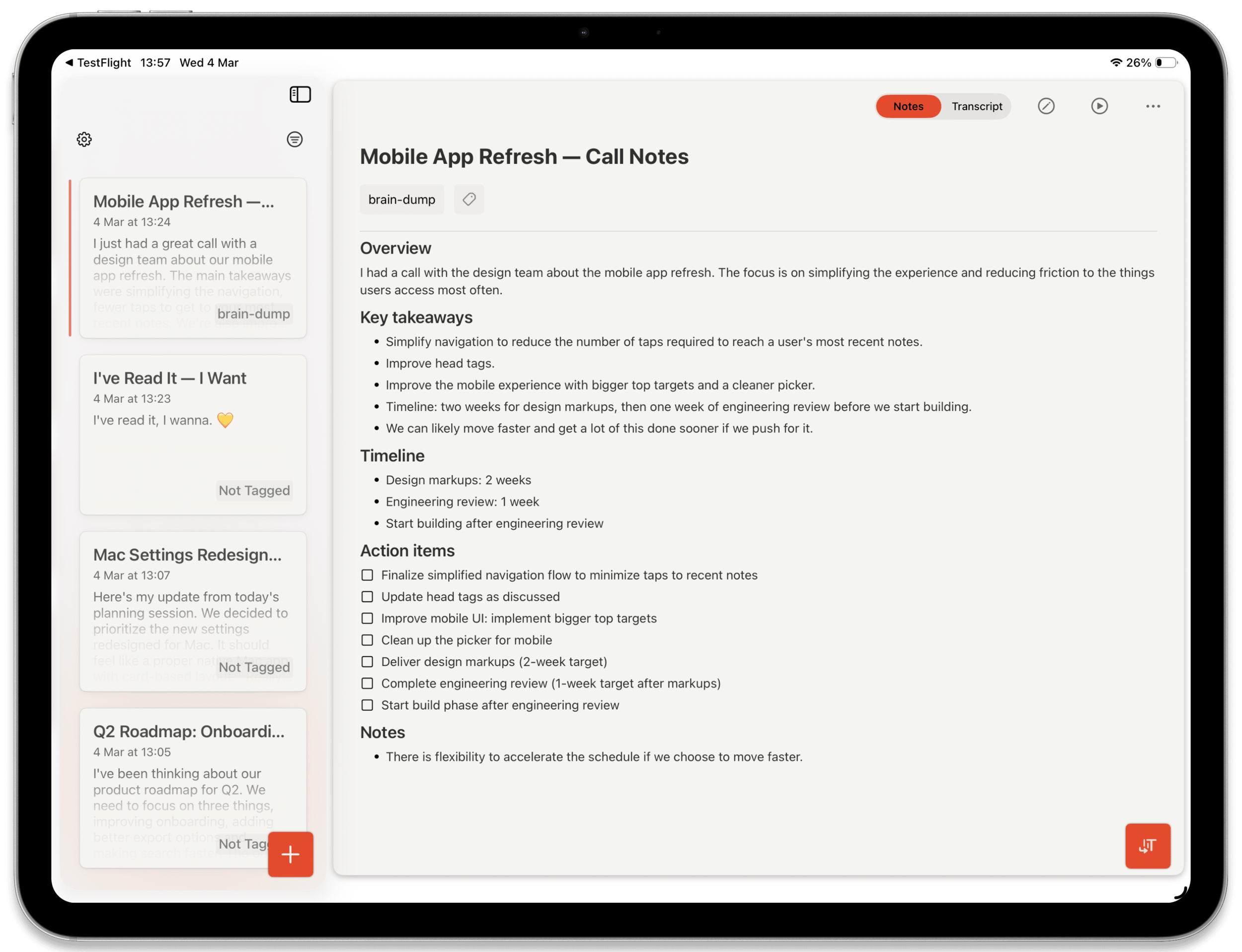
A summary, key points, and any action items are waiting on the right pane. Edit with Pencil Scribble or Magic Keyboard, send onward.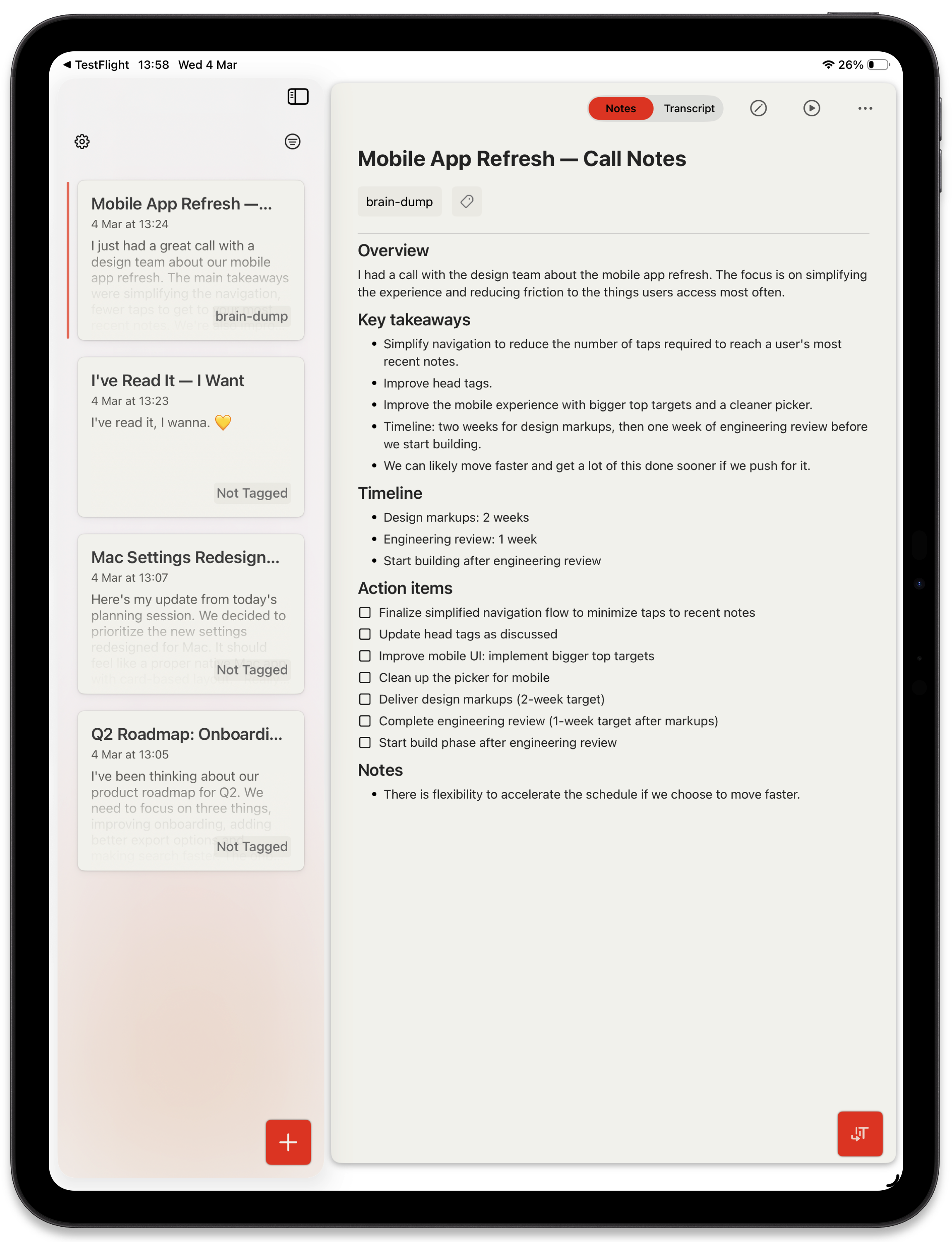
What iPad is best at
Two windows at once
Stage Manager and Split View let you keep a source document open while you draft a note in Cleft right next to it.
Apple Pencil capture
Squeeze Apple Pencil Pro to start a voice note. Use Scribble to handwrite edits straight into the editor.
Magic Keyboard control
Capture, format, and move between notes with shortcuts, no trackpad needed when you’re docked.
Local Export
Save every note as Markdown on iPad. Free for everyone, with the default folder under On My iPad → Cleft in Files; Plus can point it at an Obsidian vault or any Files location. Set it up right from iPad Settings.
Inherits the iPhone toolkit
Lock-screen widgets, Control Center, Siri, App Shortcuts, Spotlight, Focus filters. All the iPhone surfaces work on iPad too.
Couch-friendly long form
The bigger canvas and better speakers make iPad the right place for 20-minute think-out-louds and lecture capture.
Spotlight search
Cleft notes show up in iPadOS Spotlight. Swipe down on the Home Screen and type a phrase to find any note.
iPad moments worth stealing
Read on the left, capture on the right
Open a paper, transcript, or web article in one window; open Cleft in the other via Split View. Tap the voice mark in Cleft and narrate your reactions as you read: quotes, push-back, questions. The note ends up structured by Writing Style so it’s a usable artefact, not a wall of stream-of-consciousness. Setup: see Multi-window and Stage Manager below.Squeeze the Pencil, talk, get back to drawing
You’re sketching or annotating with Apple Pencil Pro. An idea lands. Squeeze the barrel. Cleft starts a new voice note in the background. Talk for thirty seconds, lock the iPad, keep drawing. The formatted note is waiting next time you open Cleft. Use Writing Style to shape that rough thirty seconds into something structured.A daily note you append to all day
Pin one note (a daily journal, a project log, a travel diary) with Pin Note, then add the Pinned Note widget to your Home Screen. The widget follows the note you pinned most recently. Tap it every time you have something to add and Cleft appends to that note instead of starting a new one. Setup: Pinned Note widget · Appending to Notes · Daily Capture RoutinesMagic Keyboard meeting station
Dock the iPad in the Magic Keyboard, tap the voice mark to start recording, and talk through the call. After, edit the summary with Scribble or the keyboard, then:- Use Send in the toolbar to push the note to Notion, Drafts, or Bear, or to create a shareable link for collaborators
- Press
⌘ + Cwith no text selected to copy the whole note - Press
⌘ + [to go back to the note you were reading before
Long-form thinking on the couch
iPad is the best Cleft device for 15-to-30 minute recordings, better speakers and battery than iPhone, none of the desk-bound posture of Mac. Prop it on a stand, hit record, talk through a problem out loud. The transcript and summary are ready when you sit back down. Mic technique: Recording Voice Notes.From iPhone or Watch, finish on iPad
Capture on the move with iPhone or Apple Watch; pick up the formatted note on iPad to edit, tag, and send onward. Sync happens through your Cleft account, no extra setup. Apple Watch · iOS · Working with NotesPull a thought back via Spotlight
Forgot which note had the quote you wanted? Swipe down on the Home Screen, type a phrase, and Cleft notes appear right alongside Mail, Messages, and Files. Tap to jump straight to the note.Start a note from the bar under your notes
The pencil and the voice mark sit in a bar at the bottom of your notes list. Tap the pencil for a text note or the voice mark for a voice note. Touch and hold the voice mark and choose Continue Note to add to your last note instead. Your last note scrolls fully into view above the bar, so nothing is hidden behind it. The bar stays in the bottom corner. Settings → General → Handedness decides which of the two buttons is outermost.Make the toolbar yours
Continue, Play, Edit, Tags, and Send sit in the note toolbar as always-visible controls rather than hiding behind a menu. Cue Card, Archive, Duplicate, Rewrite, Save Audio, and Details are yours to add, reorder, and remove: open the toolbar’s overflow menu and choose Customize Toolbar. This needs Cleft 1.15.0 or later. The Notes/Transcript switcher and the More menu always stay put, and Restore Defaults brings back the reviewed layout. Your arrangement survives a relaunch. At narrow widths anything that does not fit moves into the system overflow menu. While you edit a note, the toolbar keeps every control in its place and dims all but Done and the Notes/Transcript switcher, so finishing your edit is the one thing to do. Tap Done and everything comes back.Multi-window and Stage Manager
iPad lets you run two Cleft windows side by side, useful for referencing one note while editing another, or recording in one window while reading in the other.1
Open a second window
Swipe up to reveal the Dock, long-press the Cleft icon, choose Open in New Window. Or drag the Cleft icon out of the Dock onto the screen.
2
Use Split View or Stage Manager
Drag a window to the left or right edge for Split View, or enable Stage Manager from Control Center to free-arrange windows.
3
Resize freely
The layout adapts as you resize. A Split View or Stage Manager window narrower than about 900pt collapses to a single column; a full-screen iPad keeps both columns.
Open a note in its own window
Touch and hold a note in the list, or tap More in an open note, and choose Open in New Window. With a keyboard, press ⌥⌘O. Opening a note that already has a window brings that window forward. A note window shows one saved note, so Continue and Duplicate stay in the main window.Keep a note beside the one you’re writing
In a wide window, tap More in a note and choose Keep as Reference. Open another note and the first one stays beside it, read only, so you can read one while you write the other. Tap Open in the reference to swap the two, or tap Stop Keeping as Reference to close it. The reference steps aside while you record or write a new note, and when the window gets too narrow for both, then comes back.Windows reopen where you left them
When iPadOS brings a Cleft window back, it reopens on the note and view it last showed. Each window remembers its own, only for the account that left it there, and a note you open from Spotlight or a link takes priority. Controls adapt before they clip, stay clear of the Stage Manager window controls, and stay readable with larger text. A recording keeps going when you rotate the iPad, enter Split View, or resize a Stage Manager window, and the finished note stays open afterwards. Keyboard shortcuts act only on the window you are using, so a shortcut in one Cleft window never changes another.Saved changes show in every window at once. Edit a note’s title or summary in one window and every other Cleft window shows the change as soon as it saves, even while you’re typing elsewhere in that note. A note created in one window appears in the others after the next sync; pull to refresh to see it sooner.
Apple Pencil
- Scribble. Handwrite anywhere you can type; iPadOS converts to text.
- Apple Pencil Pro squeeze. Squeeze to start a new voice note (iPadOS 17.5+, Pencil Pro only). Squeeze again to stop any recording, whether it started in the app, from a widget, or another way. Squeezing repeatedly never starts a second recording. Toggle squeeze in iPadOS Settings → Apple Pencil.
All keyboard shortcuts
Hold Command (⌘) in any view to see the shortcuts that work there, including any you have changed. The list includes sidebar, filter, and note history shortcuts, and each one acts only on the window you are using.Notes and navigation
- ⌘ + N. New text note
- ⌘ + R. Refresh
- ⌘ + .. Open Writing Style
- ⌘ + ⌥ + S. Show or hide the sidebar
- ⌘ + /. Show or hide the filter
- ⌘ + ⇧ + [ and ⌘ + ⇧ + ]. Previous or next filter
- ⌘ + [. Back to the note you viewed before
- ⌘ + ]. Forward again
- ⌘ + C. Copy selected text while typing or searching; otherwise copy the current note
Editing
- ⌘ + ⏎. Save and finish a text note
- ⌘ + B. Bold
- ⌘ + I. Italic
- ⌘ + K. Add link
- ⌘ + ⌥ + 1 / 2 / 3. Heading 1, 2, 3
- ⌘ + ⇧ + 7. Numbered list
- ⌘ + ⇧ + 8. Bulleted list
- ⌘ + ⇧ + X. Strikethrough
- ⌘ + ⇧ + ’. Block quote
- ⌘ + ⇧ + C. Inline code
- ⌘ + ⌥ + C. Code block
While recording
- Space. Pause or resume
- Return. Finish and save
- Esc. Cancel
Lock screen, widgets, and Siri
Lock Screen widget
Lock Screen widget
Long-press the lock screen → Customize → add a Cleft accessory above or below the clock. Tap to start a recording without unlocking.
Home Screen widgets
Home Screen widgets
Voice Note starts a recording and Text Note starts writing. The medium Voice or Text widget lets you choose in one tap. Continue Last appends to whatever you recorded last, Pinned Note appends to the note you pinned, and Recording Status follows a recording until the finished note is ready.Full setup: Widgets and Action Button.
Live Activity and Dynamic Island
Live Activity and Dynamic Island
While Cleft is recording, a Live Activity appears on the lock screen with stop, save, and cancel controls. M4 iPad Pro shows the same status in the Dynamic Island.
Control Center (iPadOS 18+)
Control Center (iPadOS 18+)
Pull from the top-right, tap +, then find Cleft. The Voice Note control reads New Voice Note when you are not recording and Stop Recording while you are, so one tap starts a voice note and the next stops it. Add Text Note to open a blank note. To reopen your latest note, use the Continue Last widget instead.
Siri and App Shortcuts
Siri and App Shortcuts
“Hey Siri, new Cleft note” works the same as on iPhone. Build custom Apple Shortcuts on top of Cleft’s App Intents, or trigger Cleft from a Focus filter.Recipes: Apple Shortcuts integration.
Audio
Input devices
Input devices
Cleft uses whichever microphone iPadOS routes to it:
- Built-in microphone. Works out of the box; iPad Pro’s array is genuinely good for couch dictation
- AirPods Pro / Max. Better in noisy spots thanks to noise cancellation
- USB-C and Bluetooth headsets. Pick up automatically once paired
Permissions
Permissions
iPadOS asks for microphone access the first time you record. If recording fails, open Settings → Cleft → Microphone and make sure it’s enabled.
Tips for cleaner audio
Tips for cleaner audio
- Use a stand for long sessions; ~12-18 inches from the mic array works well
- AirPods are the safest bet in shared or noisy spaces
- Record in landscape if you’ll be near speakers, keeps the mic away from playback bleed
Settings
Open Cleft, tap the menu button at the top left of your notes list, then tap Settings. With a left-hand layout, the menu button is on the right.- General. Theme, Note view labels, Handedness, date and time format, and Keyboard Shortcuts
- Recording. Recording language, on-device transcription options, and Audio Storage
- Writing Style. Your Rules, output styles, copy format, and custom styles
- Sharing. Notion, Zapier, and other destinations
- Local Export. Save notes as Markdown files, flip the audio companion, check your storage, and choose a folder with Plus
- Widgets. In-app guide for adding lock and home screen widgets
- Account, Privacy, and Help & Support, which opens the user guide inside Cleft
Troubleshooting
Related guides
- Recording Voice Notes. Mic technique, languages, recording length
- Writing Style. Shape how Cleft formats your notes
- Widgets and Action Button. Every widget, every entry point
- Focus Filters. Shape Cleft around work, rest, and capture
- Apple Shortcuts. Automate Cleft anywhere on iPadOS
- Keyboard Shortcuts. Cross-platform reference
- iOS. The pocket sibling, where most capture happens
- macOS. The keyboard-first big sibling